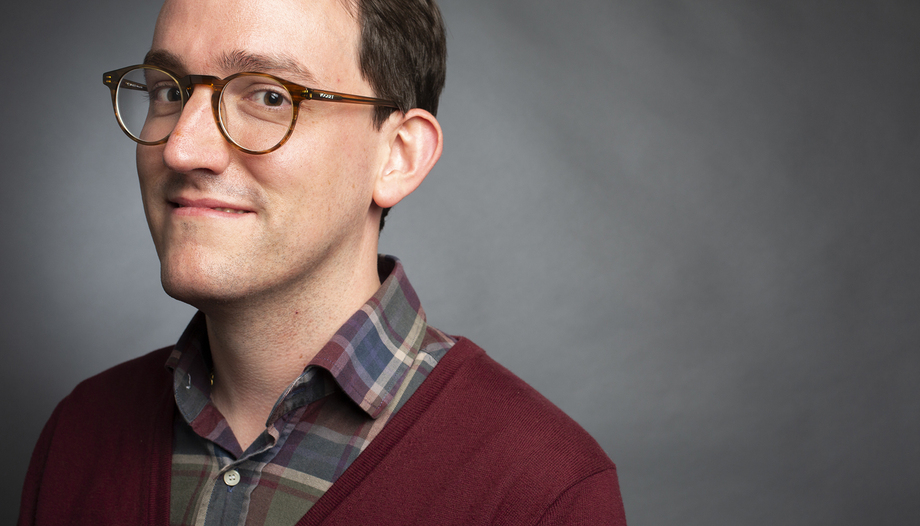
“I believe cinema is currently undergoing a clear transition”
Pablo Alzola Cerero tells Adamah Media how he discovered the connection between philosophy and cinema and how films can offer valuable insights into our present lives.
Pablo Alzola Cerero is a lecturer in Aesthetics and Theory of Art at the Universidad Rey Juan Carlos in Madrid. He has degrees in both Philosophy and Audiovisual Communications. He has written books on the films of Terrence Malick (El cine de Terrence Malick: La esperanza de llegar a casa), on The Silence of God in Cinema (El silencio de Dios en el cine) and on The Adventure of Beauty (La aventura de la belleza: Filósofos, escenas e ideas estéticas). He is currently on sabbatical at the Department of Film Studies at King’s College London, where he made time to speak to Adamah Media.
You have degrees in both Philosophy and Audiovisual Communications…. But aren’t these in some way incompatible, almost a contradiction in terms? Philosophy is about the interior, thought, going deep. Audiovisual Communications are about the exterior, merely what we see, the superficial level. What would you say to that?
Yes, at first glance it might seem that philosophy and cinema are at odds with one another. But I don’t think they are. Firstly, I’ve found the connection between the two in my own life: ever since I was a teenager, I’ve loved cinema, both making films (short films, with my friends) and watching them; likewise, when I was sixteen, I discovered philosophy thanks to a brilliant teacher I had at school (Javier Aranguren, who is also a great writer).
Later, when I went to university, I decided to study two degrees at the same time: Philosophy and Audiovisual Communication, as I was passionate about both. In my second year at university, I realised it was possible to build a bridge between those two worlds: it was possible to write about how films—using their own visual, auditory and narrative language—are capable of inviting the viewer to engage in philosophical reflection.
Robert Pippin says that “some films can be means of rendering ourselves intelligible to each other, rendering some feature of human life more intelligible that it otherwise would have been.”
Would you say that cinema has, as a phenomenon, added to or harmed culture? Would we be better off simply reading and going to the theatre? Has it simply dumbed down culture? Or, if you disagree with this, which I guess you do, and in more positive terms, how would describe cinema’s contribution to world culture? How are we better off with cinema?
Like any other art form, cinema can help to enrich a person’s cultural life, but it can also impoverish it. In the early decades of the 20th century, some cultural philosophers, such as Walter Benjamin, argued that cinema—and mechanical art in general—brought about the destruction of the work of art as it was traditionally understood.
Benjamin claimed that the effect of cinema was to stun the viewer, to shock them, to scatter their attention (he used the word ‘shock’).
Over the years, we have seen that cinema is also capable of doing people a great deal of good: there are films capable of entertaining us, of cultivating our contemplative gaze, and even of presenting us with moral dilemmas on a par with a Dostoevsky novel or an Ibsen play.
Stanley Cavell, one of the first philosophers to write about cinema in the 1970s, argues that cinema has a Socratic vocation, for it is like a mirror in which we see ourselves reflected and which helps us to examine our own lives.
Another devil’s advocate question… Isn’t cinema just an escape from reality? Shouldn’t we be focussing more on engaging with reality? Isn’t cinema necessarily superficial? Most people who have read a good book and then seen a good film say the book is better. Or, again to put the question more positively, how does cinema help our engagement with reality?
That’s a very interesting question. Since the dawn of cinema, there has been talk of two paths that this medium has followed: on the one hand, the path of fantasy, of escape from reality, represented in the early years of cinema by the films of Georges Méliès; on the other hand, the path of the documentary, that is to say, cinema as a witness to the life unfolding around it, represented by the Lumière brothers.
I believe that, whether they follow one path or the other, good films always offer us valuable insights into our present. There are slower, more contemplative films, such as those by Terrence Malick or Andrei Tarkovsky, which help us open our eyes to the beauty of nature; other films, with more pace and narrative drive, such as those by Steven Spielberg or Martin Scorsese, draw us into stories as gripping as those told in good novels.
I don’t think it’s right to judge cinema by the standards of literature, as each has its own language and possibilities: that’s why, when we come across a good adaptation of a book (I’m thinking of To Kill a Mockingbird, The Pianist or Hamnet, for example), it’s because the film has managed to add something that wasn’t in the book.
Would you agree or disagree with the arguments put forward in this Adamah Media article? In the article, the author says:
“American entertainment culture is stuck. Originality is dead. Nobody wants to take a risk in their storytelling. At best, we get one to two CGI slopfest renditions of classic works per year, carried entirely by the weight of impressive visuals and cinematic grandeur (Dune is a fitting example); one to two breakthrough ‘masterpieces’ every five (but was Oppenheimer really that good?).”
And: “Modern Hollywood operates from an anti-ethos that has destroyed its capacity for genuine storytelling. They’re not trying to inspire you, they’re actively inoculating you against inspiration.”
What would you say to that?
As for the first quote, I would say I partly agree and partly disagree. I do believe that major Hollywood cinema—that is to say, big-budget cinema—is largely stagnant, and that the major studios are opting for safe formulas such as remakes or CGI adaptations of animated films.
At the same time, I believe that within Hollywood there is a smaller-scale cinema made by highly talented directors, which focuses on telling small stories with enormous dramatic power: I am thinking of directors as diverse as Alexander Payne, Kelly Reichardt, Chloé Zhao, Noah Baumbach, Greta Gerwig and Celine Song, amongst others.
In response to the second quote: it is true that in our time it is difficult to tell stories like those of decades past for the simple reason that the moral values shared by the general public are fewer, and are sometimes subject to many caveats and ambiguities.
A good story needs a conflict with which viewers can identify, and every conflict entails an idea of what is morally good and bad.
This lack is, in a way, the reason for the proliferation of stories with a thin narrative thread, or with characters whose inner goal is not so clear and whose motivations are ambiguous (Oppenheimer is a good example of this trend). Ultimately, these stories and characters are like an X-ray of our contemporary soul and, in part, an incentive to continue down that path.
On this topic, might it be that the best creatives have moved on to the series? We really do seem to be in the world of series. Would you see this as positive? But people can get obsessed with series, e.g. the phenomenon of binge-watching. Or their lives become the series they are watching, they can hardly or think about anything else (though perhaps this has been happening for decades already with soap operas, ‘telenovelas’…)
Yes, I think TV series are a phenomenon that has overtaken cinema, at least as far as Hollywood is concerned. It is said that many Hollywood creatives—screenwriters, in particular—have moved into the TV series industry.
For fifteen years or more, we have seen a proliferation of television series that have displayed visual power and narrative skill as valuable as those of the best films: The Sopranos, The Wire, Breaking Bad, Homeland, House of Cards, Mad Men, and, more recently, Game of Thrones, The Crown, Stranger Things, This Is Us, and so many others.
Personally, I’m not really into series, simply because I don’t like committing to such long-running stories that take up so much of my time. I think very long series end up losing their originality and narrative tension. I prefer, if anything, mini-series, such as Band of Brothers, Chernobyl, Generation War, or the Italian series Esterno notte, which I loved.
What makes a good film and how can we get the most out of the films we watch?
First and foremost, I believe that a good film is one that strikes a balance between all its elements: by this I mean, on the one hand, formal elements such as shots, camera movements, editing, and the use of sound and music; and, on the other hand, narrative elements such as the plot, the script’s turning points, and character development…
Furthermore, a good film invites us, as we have noted before, to reflect: even if it is telling us a very specific story (think of Perfect Days, directed by Wim Wenders: the story of a man who works cleaning public toilets in Tokyo), this story achieves a universal scope, because it touches on some key aspect of the human condition.
As Kant said, a good work of art displays such unity and coherence that it seems like a work of nature: the same is true of many good films.
Why do you like Terrence Malik so much? He can be very slow! And he does have the annoying habit of giving lots of voice-overs. Would he be the greatest director of all time for you?
I like Malick because my own life journey has led me to him. When I was studying for my degree in Philosophy at the University of Navarra, a professor of Philosophy of Language, Jaime Nubiola, encouraged me to write an essay on The Tree of Life, and Malick has been with me ever since.
I wrote my doctoral thesis on him and then went on to write a book as well. His films are very peculiar, it’s true, but I like him because he has achieved a unique cinematic style through which he is able to provoke very human questions and reflections (philosophical, in a way).
The experience of watching a Malick film is not easy; it is not entertaining (as is the case with Tarkovsky), but if you manage to stick with it, you may find surprises that would not otherwise be revealed. I wouldn’t say that Malick is the greatest director of all time, because some of his films are not for every viewer: I would lean more towards classic directors such as John Ford, Frank Capra or Alfred Hitchcock.
You have written a bit about the silence of God in the cinema? Why that theme? For example, why not the voice of God in the cinema? Do you think God is particularly silent in cinema? If so, what does this tell us about cinema?
Four years ago, I wrote a book entitled El silencio de Dios en el cine (The Silence of God in Cinema [ed: at present only in Spanish], which addressed a concern I had held for some time: a concern regarding films from recent years which raise questions of a religious or transcendental nature, almost always without providing an answer.
I am referring to films such as Ida, Silence, Calvary, Of Gods and Men, Nomadland, Son of Saul, Three Billboards Outside Ebbing, Missouri and Lady Bird, amongst others. In all these films, which are of high cinematic quality, God is present in some way, but almost always as someone who hides, who remains apparently silent.
I believe these are films that reflect how many people today approach the question of God: amidst doubts and darkness, God hides and at the same time makes himself present.
How do you see and what do you hope for the future of cinema? And how do you see the future of reading?
I believe cinema is currently undergoing a clear transition towards something different. The experience of watching films has changed: we go to the cinema less and less, and we are increasingly unable to watch a film from start to finish without looking at other screens, such as our mobile phones. It is not a neutral transition, it seems to me, as it involves a loss of our ability to pay attention, to allow ourselves to be captivated by a good film.
Your latest book, The Adventure of Beauty (alas, also just in Spanish for the moment), is about beauty and cinema. How do these two paths intersect?
In my Philosophy of Aesthetics classes at university, I often use film scenes to illustrate ideas and prompt reflection. So, I thought to myself, why not write a book in which cinema introduces us to the great philosophers’ thoughts on beauty? That is what I have tried to do with this latest book.
What would be your top 10, your ‘must see’, films of all time?
I’ll list ten titles, but they’re very personal. I’ll put them in chronological order:
1. It’s a Wonderful Life, dir. Frank Capra, 1946
2. Ordet, dir. Carl Theodor Dreyer, 1955
3. The Man Who Shot Liberty Valance, John Ford, 1962
4. Babette’s Feast, dir. Gabriel Axel, 1987
5. The Dead, dir. John Huston, 1987
6. Au Revoir Les Enfants, dir. Louis Malle, 1987
7. Shadowlands, dir. Richard Attenborough, 1993
8. Smoke, dir. Wayne Wang, 1995
9. Perfect Days, dir. Wim Wenders, 2003
10. The Tree of Life, dir. Terrence Malick, 2011

Pablo Alzola Cerero
Pablo Alzola Cerero is a lecturer in Aesthetics and Theory of Art at the Universidad Rey Juan Carlos in Madrid. He has degrees in both Philosophy and Audiovisual Communications. He has written books on the films of Terrence Malick (El cine de Terrence Malick: La esperanza de llegar a casa), on The Silence of God in Cinema (El silencio de Dios en el cine) and on The Adventure of Beauty (La aventura de la belleza: Filósofos, escenas e ideas estéticas). He is currently on sabbatical at the Department of Film Studies at King's College London.

