The risk of love
As the Christmas season comes to an end, Toby Lees considers that truth isn’t something merely abstract. It is profoundly personal and most expressed in the vulnerability of love.
I remember vividly the first time I heard those three words that change everything – “I love you” – said by my first serious girlfriend, that first summer holiday of uni.
Okay, it wasn’t actually the first time, my mum and dad had said them plenty of times, grandparents too, but this was different. It was “I love you” from someone who didn’t have to say it, from whom it wasn’t just expected, but who had said it anyway and meant it.
Life before had been love that was taken for granted. This was love experienced as a gift. She didn’t have to say these words, and yet she had, and everything felt different.
And yet over time, occasional doubts would creep in, particularly during time apart, living in different cities. Those words would be said down the telephone, at the end of emails, letters, but does she really mean it? Do I really mean it? If we did, would we not be in the same city right now? Words once said and heard with conviction, but doubt can creep in, and it’s awful.
Just for the record, this is not the story of my broken heart and how I came to be a Catholic priest in the Dominican order! But those three words said and not meant, well, they mean nothing, or actually worse than that, they’re the cruellest deception, because if you love someone and you know they love you: life is different, you live differently, you gladly sacrifice for them, you’ll do anything for them.
To delude someone or to live in delusion about love is just about the worst thing you can do, because love is the most important thing.
So ‘truth’ and “I love you” must go together.
There are many things you could lie to me about; tell me I’m witty and charming, and I wouldn’t be devastated to find out you’d only said it to make me feel good, but say “I love you” and not mean it, that would be devastating. But how can we know for sure?
Science can tell us many things that are true about the world, but it cannot test love one way or the other. There is no experiment that would give us the answer that we need to know more than any other. The truths that matter to us most don’t exist on the pages of textbooks or as words on a screen, the truths that matter to us most are incarnated, they are personal.
In The Wild Orchid, a novel by the Nobel-Prize winning writer Sigrid Undset, Paul, a young man raised by divorced parents, is speaking with his atheist mother who prides herself on her open-mindedness, albeit an open-mindedness quite shut off to religion. They are discussing the nature of truth, and she amuses herself with the quip: “What is truth? A Roman official once asked, and he made himself famous through the centuries by that stroke of wit.”
Paul retorts: “To my mind, the reason he became famous was that his saying was addressed to a man who declared that he himself was the truth.”
Julie, the mother, then retorts by questioning the sort of company that he’s been keeping lately, particularly a stay he had with a family of Catholics.
Paul carries on saying, “If the truth is not a person, I’m afraid it’s a fiction.”
“But science, Paul,” the mother responds, “that gives us the key to truth.” “I don’t know anything about that,” says Paul. “It teaches us a whole lot of things which are true, but that’s quite another matter.”
Paul has come to realise that there are truths which matter more deeply to us than the ones which science can furnish us with, because, useful and fascinating as those can be, they do not give meaning to a life.
Paul, you see, has lately fallen in love with a girl, and he also believes that she truly loves him in return. Truth, he has come to realise, is profoundly personal without being purely subjective.
His mother, scarred by her own experience of love, then quotes a friend of hers saying that there are three things for which we all ought to be thankful: “That we can’t see into the future; that we hadn’t the pluck to shoot ourselves when we wanted to; and that we couldn’t marry our first love.”
Paul, quietly but confidently, informs his mother that it is precisely the third of these things that he intends to do.
His mother ruefully says, “It’s what I did”, and not looking at Paul but into the flames of the fire says, “and when I think of it all – it sometimes happens as one grows older, that one lies awake more at night – I think of what I believed your father to be and what he was in reality, and what I believed myself to be and how different I was too – that it all seems to me pretty sad.”
I love you… We want it to be true, and we want it to be forever. And yet, all of us in our families will know the pain, the sorrow, the devastation of love lost, love lied about, love ended.
Is that the end of the story, is that what we’re fated to: uncertainty, disappointment, disillusionment? Even for those of us who have had the privilege of stable love, of happy marriages, is there not always the spectre of death?
This, perhaps, is as far as the one who believes in science alone can go: is love just an uncertain chemical cocktail that will end in death and disintegration?
Yet across the Western world right now, a younger generation is questioning their atheist parents and wondering if there might not be more to life than this. Is there a love that will not fail, will not die, is there a love that is true? Is there a love that can sustain all our other loves, a love that can give life to that which otherwise seems destined to wither and to die?
For there is a fatal flaw in even the most steadfast, the most heroic, human love: we cannot prevent the ones we love from dying. We can give up our lives for them, but that only delays the point of death.
Is despair all there is for us? Do we eat, drink and be merry, for tomorrow (or perhaps the day after) we die? Could there be more than this?
Love demands that we ask this question: as an atheist father of a new-born child wrote to me recently, asking to meet for a pint: “This whole thing [his new-born baby] is making me question my thoughts on religion or that we’re in a simulation.”

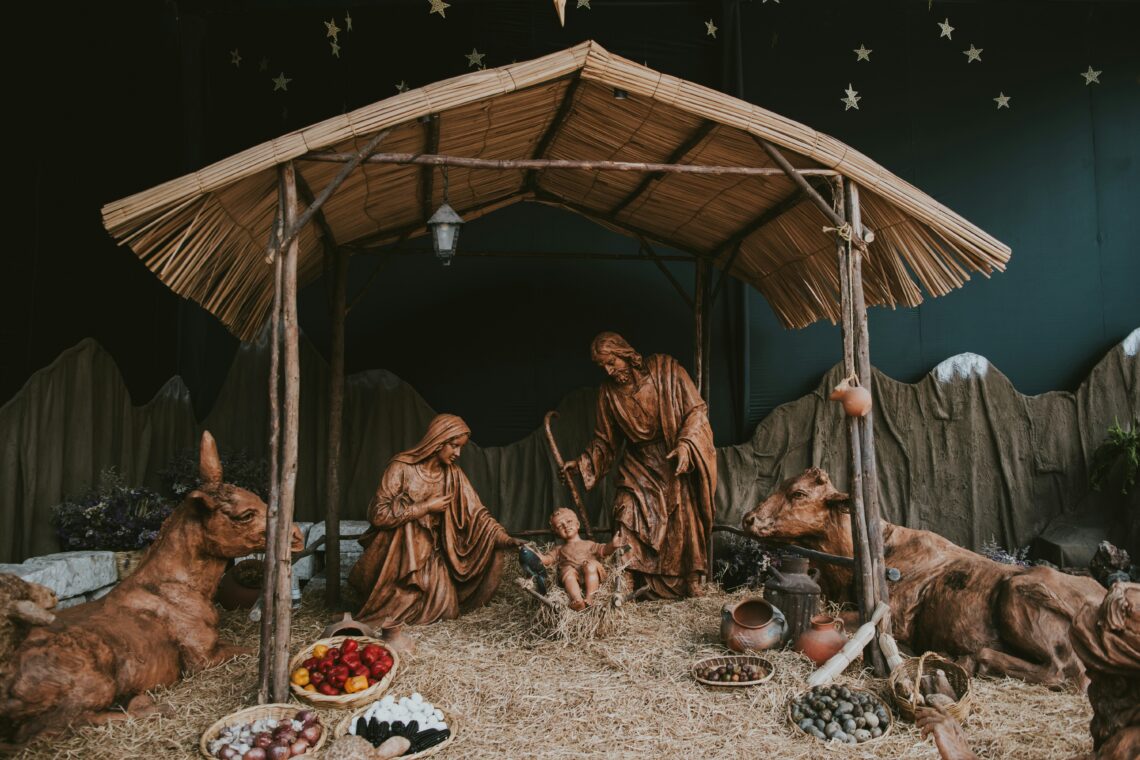
This is precisely what we have celebrated at Christmas. The Eternal Word of the Father, the Word that is Love, the Word that is Truth, has come to dwell among us, has come to give us life in abundance. Truth and love in one person – God with us.
Christmas is the celebration that God’s love is not a wishful thought, an abstract idea, not even a distant word, but an incarnate reality, God who came to live alongside us. The God who is Love is personal.
This is the love that heals, the love that is true, the love that opens up eternity. This is, as the great Victorian poet Gerard Manley Hopkins wrote, ‘Infinity dwindled to infancy’ – all the infinite power of God to be found in a child who can be held in a mother’s arms. And this Love has a name, Jesus.
The Scriptures suggest that, in the Garden of Eden, there had been a time when Adam and Eve had walked in friendship with God in the cool of the evening, but sin destroyed that relationship. When God came to walk once more with them, they, already covering themselves up from one another, hid from him.
Sin destroys relationships; sin is opposed to love. At the heart of that first sin was a failure of trust. They had not trusted in God, not trusted in his word; they thought that God was trying to hold something back from them, and the Serpent convinced them that if they ate the fruit of the tree, they would have it.
But what happened was that they lost the good that they already had. And the story of the Scriptures after that first sin is somewhat of an unravelling. Distrust breeds further sin and distrust, and nothing that God says can seem to put an end to it.
And, what we see in the course of the Scriptures, we can also see in our own lives.
For most of us, our lives began with the secure love of our parents, but a combination of the sin of others and our own, means that trust and the capacity to love often diminishes as we grow older.
And worst of all is when we’re hurt by the ones who love us. We’re then confronted with this terrible choice of staying vulnerable or protecting ourselves.
As CS Lewis put it: “To love at all is to be vulnerable. Love anything and your heart will be wrung and possibly broken. If you want to make sure of keeping it intact, you must give it to no one, not even an animal. Wrap it carefully round with hobbies and little luxuries; avoid all entanglements. Lock it up safe in the casket or coffin of your selfishness. But in that casket, safe, dark, motionless, airless, it will change. It will not be broken; it will become unbreakable, impenetrable, irredeemable. To love is to be vulnerable.”
But how could captive Israel, how could all those who came before us, how can we love in a broken world, and how can we trust?
We hear that we are loved, but we need more than words. When one lover betrays the other, and seeks to repair the damage, the profuse apologies and the promise that “I do really love you” is often met with, “It’s not enough for you to tell me, I need you to show me.”
It’s a sentiment given expression in perhaps the greatest song released in 1990, ‘Extreme’s More than Words’, in which Nuno Bettencourt sings: “What would you do/ If my heart was torn in two?/ More than words to show you feel/ That your love for me is real/ What would you say/ If I took those words away?/ Then you couldn’t make things new/ Just by saying ‘I love you’”
But the great and wondrous paradox of Christmas, unlike in our human relations, is that at Christmas, God does make all things new, with an incarnational, “I love you”. The one who has done no wrong, proves to us in our sin-induced doubt, proves to us in ‘more than words’, in flesh and blood reality, that his love for us is real, as he takes on our human nature so that we might trust in him and in His ways and be led back into right relation with him and one another.
One thing I didn’t mention at the beginning of this article is that, when I heard those words, “I love you”, they weren’t the initiative of that girlfriend; they were a response. It was I who said the words first, and they felt like the riskiest, but the most necessary words, I had spoken in my life to that date. I’d taken a chance and said them, uncertain as to what the response would be, because they just had to be said or else I felt like I would explode.
And God has done quite the same for us. In loving us so much that he would humble himself to become like us, in opening himself up to all the hatred and bile of human sin for the sake of showing his love, and in continuing to offer himself, Body, Blood, Soul and Divinity, to us in the Eucharist, God has taken quite the most extraordinary risk in loving us.
He has entered the world as a little child to show his love for us, and for all, with no guarantee of being loved in return. But that is what love does, it offers, it takes risks, but it never coerces. When we look at the baby in the manger this Christmas, we hear the gentle whisper of God, saying, “I love you!”
This is an abridged and slightly edited version of a message first published on the Radio Maria website. The original can be found here: https://radiomariaengland.uk/fr-toby-lees-op/ (scroll down to the January 2026 message). It is re-published in Adamah Media with the author’s permission.
Like what you’ve read? Consider supporting the work of Adamah by making a donation and help us keep exploring life’s big (and not so big) issues!
Toby Lees
Fr Toby Lees OP is a Catholic priest and member of the Order of Preachers (known as the Dominicans). He was born in London and studied law at Cambridge University, going on to be a solicitor for seven years with a city law firm. After discerning a call to the priesthood, he specialised in moral theology in Rome, writing his thesis on the passion of sorrow and the vice of acedia in St Thomas Aquinas and what his thought might contribute to a contemporary understanding of depression. His particular academic interest is the crossover between moral theology and psychology. He serves at the Dominican Priory at the Rosary Shrine, Haverstock Hill and is Priest Director of Radio Maria England. He loves all sport, but especially rugby and cricket, and he enjoys running and swimming on Hampstead Heath. He also loves real ale, fiction, and pilgrimages, and is always trying to work out a way to walk yet another Camino to Santiago.

