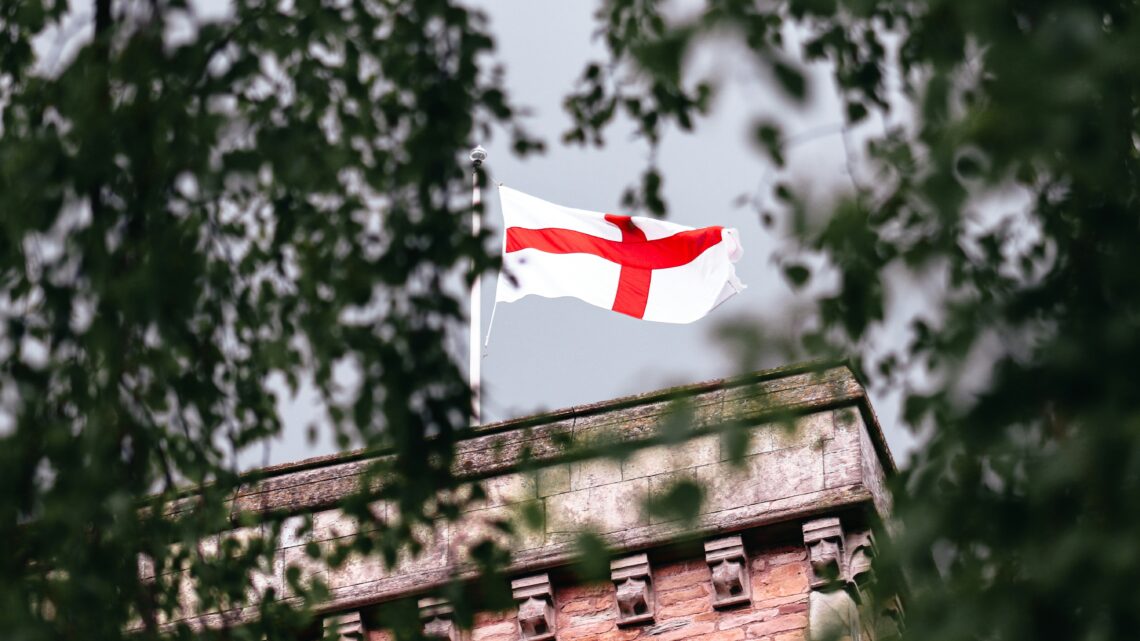
The fight for the flag
Those putting up flags for nationalist ends and those who want to take them down share in the same fundamental error, says Joseph Evans. They both fail to grasp what the flags actually mean.
It only needs a Hollywood-level knowledge of history to appreciate a flag’s importance in a battle. A focus of unity, soldiers on seeing it are fired to enter the fray. Fluttering in the wind, it represents all their national pride and hopes.
C.S. Lewis put it well in his Abolition of Man, “In battle it is not syllogisms that will keep the reluctant nerves and muscles to their post in the third hour of the bombardment. The crudest sentimentalism . . . about a flag or a country or a regiment will be of more use.”
That is why it is so essential to protect the flag from enemy attack or to recapture it if taken. Loss of the flag comes close to loss of the battle, even, in a sense, loss of the nation. For the same reason, this is also why the flag is such treasured booty. To take your foe’s flag is to capture their heart, almost to rip it out.
And all this might explain the curious multiplication of flags around Britain in recent months, as, in a sort of popular movement, St George’s and Union Jack flags have been going up in cities, towns and villages.
Often placed on lamp-posts, with the help of cherry pickers or ladders and high enough not to be easily pulled down (who would want to do so? Ah, read on), they can also be spotted on motorway bridges and more recently on roundabouts. I have even heard of them being painted on drain and manhole covers.
Or sometimes there are other British flags, like the Welsh flag of St David or more specifically royal ones, as if to make the point that national unity also involves the various countries and institutions which constitute it.
But why the recent proliferation of these flags? Are we suddenly at war? Some people seem to think we are.
To understand what is going on, it might help to take a step back to explore the British psyche and with it our attitude to flags. Ever non-demonstrative as a people (a legacy of our recent Protestant past), we usually confine national flags to royal palaces, Anglican cathedrals or government offices.
From time to time, however, they are taken from the bottom of drawers for royal jubilees or, more frequently, for football World or European Cups. They then flutter around our streets, expressions of our fluttering hopes for the trophy in question to ‘come home’ (i.e. for us to win). When we are knocked out, they are then despondently returned to storage.
Following our nation’s unwritten codes, everyone knows that on such, and only on such, occasions is it appropriate to use them – though even then it is seen as a somewhat ‘lower-class’ thing to do. The educated and the higher classes would never descend to such a crass display of sentimentalism.
In recent years, however, flags have been more used, particularly by far-right groups, and this takes us to the heart of the battle. In such uses, displaying the flag of St George or the Union Jack seems more xenophobia than patriotism. And this has led to a certain, even widespread, diffidence about their display, which I share but, as I will now explain, for more reasons than the usual ones.
Discontent
And then we come to the current trend of flag flying which seems to express a wider discontent and deeper questions about the direction our society is taking. People complain (behind closed doors) that while expressions of patriotism are frowned upon, other more ‘Woke’ causes are encouraged.
I have known someone in an Oxford University college who was ordered to remove a Union Jack flag from their window while the rainbow LGBT+ flag was flying with pride above the building. And, as this BBC article explains, while some local councils ordered the removal of British flags, ‘a small number of Palestinian flags flown from lamp-posts’ were left in place. (Though, from the evidence of the article, it would seem that, as a whole, local authorities have taken a balanced and pragmatic approach to the flags.)
Put simply, ordinary people are putting up flags because, in a way they might not be able to articulate (and flags, as we have seen, of their very nature reach something visceral in us, beyond rational formulation), they want to defend their country, which they feel is threatened.
This movement expresses understandable concern about the speed of demographic change, increased criminality and the arrival of many new people who often have no understanding of or sympathy with our core national values. Indeed, at times, they might firmly repudiate them.
But is our country threatened? And might not the threat be more interior, within ourselves, than one from outside?
One certainly gets a sense that Europe has lost all confidence in itself and its history. The European project, considered tainted by colonialism, is viewed by many with suspicion, if not downright hostility. Our past is something to apologise for, not celebrate.
This is also visible in Britain. The repudiation of patriotism is one more manifestation of this and there are those who reject national flags because they reject the love of country which goes with them. A previous pope, Benedict XVI, put it well when he wrote of the ‘peculiar Western self-hatred that is nothing short of pathological’.
Of course, such a negative attitude shows profound ignorance and fails to appreciate the treasures of art, thought, scientific development and so much good which Europe has brought to the world. And, as is often the case, one extreme, ignorant position engenders an opposing reaction.

So much current rhetoric targets migrants who have almost become mythical monsters, like the ones parents invent to get their children to go to bed at night.
As if they were saying, “If you don’t go to bed quickly and stay there, a migrant might come and take you!” Terrified toddlers then race to their rooms to dive under their bed covers.
Indeed, one of the reasons why people are putting flags high on lamp-posts is because, they claim, ‘foreign people’ had taken the previous ones down.
‘Foreigners’ – according to this logic – are threatening the very identity of our nation (as well as taking our jobs and all the rest), so let’s enter the fight, fired by our national flag! Fine, but before we do, shouldn’t we just ask ourselves what those flags are telling us? If we are to have such devotion to them, surely we should know what they mean.
Meaning
Because flags invariably have a meaning. What is the meaning of the Union Jack and the flag of St George which will inspire us in our fight against migrants? A bit of historical perspective always helps.
Someone who really did know their history might well have good reasons to choose the flag of St George as their ensign of choice. Because a bit of research reveals that this flag became popular in England precisely at a time of anti-Islamic fervour. (For let’s be honest with ourselves, though ‘foreigners’ in general are painted as despicable – as we seemed to discover in Brexit – Muslim ones are considered the worst.)
From the 12th century onwards this flag, a red cross on a white field, which was earlier used by the city state of Genoa, was associated with the great military saint George and used by English and French troops in the ‘Kings’ Crusade’ of Philip II of France and Henry II of England. George was a real historical martyr, an army officer killed in the fourth century by the Emperor Diocletian for converting to Christianity, but various legends sprang up around him, not least the killing of the dragon.
As a soldier saint, not surprisingly he was an attractive figure for the European Christians in their fight against Muslim hordes during the Crusades. The dragon – more correctly seen as an expression of Satan whom the saint combatted by refusing to yield to the pagan ruler – could easily be seen to express the Islamic forces the Christians were trying to expel from the Holy Land.
If we stopped there, the choice of the flag of St George would be highly appropriate. It was used to fight Muslim invaders then and it is being used by some for the same purpose now. But the point is, in adopting this flag, the 12th century French and English kings were guilty of the same shallowness in their time as we are guilty of in ours. They too should have asked, what exactly does this flag mean?
Because if they had actually looked at the flag, they would have been moved to think in a very different way. And so with us today. Following the basic conventions of heraldry, the white background, known as the ‘field’, represents peace and sincerity. Negative attitudes towards migrants are neither peaceful nor sincere.
But more relevant is the actual symbol on the field, the red cross. The cross is the principal Christian symbol and points to the death, precisely on a cross, of Jesus Christ. Indeed, early Christian art often shows the risen Christ bearing a white banner with a red cross, a sign of his victory over death.
Whereas certainly red symbolises courage and would have spurred the warrior to be ready to shed his blood for England, it expresses even more the blood of Christ.
And Christ did not seek the blood of others. Rather, he shed his own blood to save us. On the cross he prayed for the forgiveness of his killers. The cross then became the great symbol of unity, breaking down the ‘wall of hostility’ between Jews and Gentiles, as St Paul, the first great Christian theologian, wrote in his letter to the Ephesians (Eph 2:14).
The blood-red cross speaks to us of sacrifice for the forgiveness of others, not of their exclusion.
And if we go to the Union Jack, precisely the flag of unity between England, Scotland and Ireland, the same message is reaffirmed. Added to the cross of St George – or really the cross of Christ – comes from Scotland the diagonal cross of St Andrew, one of Christ’s leading apostles.
This recalls the martyrdom of the saint on a diagonal cross. Tradition records him greeting the cross when he saw it as a chance to share in the sufferings of his Lord Jesus. It is believed that, in his humility, he asked to be crucified in this manner as he did not consider himself worthy to die in the same way as his Master. The message is one of humility and self-sacrifice.
And finally, the Union Jack includes yet another cross, the Irish cross of St Patrick, a red diagonal cross on a white background. Though not martyred himself, the saint had deep devotion to the cross and lived out the same forgiveness which his Lord Jesus had pioneered.

In every case, the cross speaks of forgiveness and unity. It tells us salvation and peace are to be found in Christ Jesus, who enjoined us to welcome the stranger and made a Samaritan, a hated ‘foreigner’, the hero of one of his best-known parables (see Lk 10:25-37). Our nation’s, our continent’s, future depends on us embracing our Christian heritage.
Those who use flags for nationalist or exclusionist purposes or those who reject them as part of a wider rejection of Europe’s Christian past actually share in the same fundamental error. They are wilfully ignoring what these flags actually mean. They both exclude the very faith and values which forged Europe and Britain and made them great. Because, for all their faults, great they are.
This exclusion can be in the name of a nationalist and/or populist ideology which uses a Christian symbol while completely emptying it of its meaning. Or it can be in the name of a blind and narrow secular ideology which, for all its apparent tolerance, refuses to see how Christian our continent still is and how Christianity gave it most of what is good in it.
By the way, for information, like almost all Brits I am historically an immigrant. My Jewish grandmother on my mother’s side was an immigrant from Switzerland. That part of my family came mainly from Germany and France. Let him who is without foreign lineage cast the first stone. Or maybe that should be, put up – or pull down? – the first flag.
For an earlier article (February 2021) by Joseph Evans on patriotism and nationalism, see here.
Like what you’ve read? Consider supporting the work of Adamah by making a donation and help us keep exploring life’s big (and not so big) issues!

Joseph Evans
Fr Joseph Evans is a Catholic priest and a member of Opus Dei. He has worked as a journalist and youth worker, and is currently a university chaplain in Oxford. He is co-founder and Editorial Director of Adamah Media and a poet. His most recent work, “When God Hides”, was published by SLG Press in 2025.


2 Comments
Ricardo
Incredibly insightful article. I think people in the West are now far too ashamed of their unique history and cultural contributions, with a dominant narrative portraying Westerners as history’s villains– yet this is often too simple a conclusion… and any attempt at constructive patriotism is viewed with suspicion as some jingoistic echo of empire. But when the West is cut off from its Christian roots it loses oxygen, it atrophies, with those three crosses on the Union Jack losing their meaning..
Ricardo
I agree that if the West is cut off from its Christian heritage, those three crosses on the Union Jack lose much of their meaning. I think it is possible to both recognise the significant structural harms brought on by colonial extractivism (affecting billions today and exemplified by events such as the 1942 Bengal famine) and still celebrate British contributions to literature, science, and the arts. Flying the Union Jack cannot simply be an exercise in exclusionary politics, yet hiding the flag due to potential jingoistic connotations doesn’t help– it makes it all the more attractive to coopt the Union Jack as a symbol of exclusionary populism against “wokeness”.