Poetry will save the world
Jaqueline Leftwich pens a love letter to poetry.
Recently I went back to reading poetry and, more specifically, to trying to learn poems by heart. It used to be something I did regularly when I was at school in France as it was a requirement in French schools to memorise poems and be able to recite them.
Beyond helping me to exercise my memory and improve my diction and pronunciation, I remember how helpful it was to know these poems on my long way home in the tube after school. The trains were crowded, people around me were unhappy and cranky in the usual way Parisians can be at 5pm in the afternoon on a weekday. But for me, when the train was so crowded that I couldn’t open a book to read, I would be reciting in my head the latest poem learnt in class.
Somehow, I always forget the effect poetry has on me. It is like a wave. Something that submerges me and brings me joy and makes me feel whole. And if Dostoevsky can say that beauty will save the world, I will claim here that poetry can do the same. Because poetry and beauty are the same thing. They have the same nature.
________________________________________________________________________
“Look, do you see that poem?” she said suddenly, pointing.
“Where?” Jane and Diana stared, as if expecting to see Runic rhymes on the birch trees.
“There… down in the brook… that old green, mossy log with the water flowing over it in those smooth ripples that look as if they’d been combed, and that single shaft of sunshine falling right athwart it, far down into the pool. Oh, it’s the most beautiful poem I ever saw.”
“I should rather call it a picture,” said Jane. “A poem is lines and verses.”
“Oh dear me, no.” Anne shook her head with its fluffy wild cherry coronal positively. “The lines and verses are only the outward garments of the poem and are no more really it than your ruffles and flounces are you, Jane. The real poem is the soul within them… and that beautiful bit is the soul of an unwritten poem. It is not every day one sees a soul… even of a poem.” (L.M Montgomery, Anne of Avonlea)
________________________________________________________________________
Much could be said about poetry. You could talk about the lines, the rhymes, the rhythm. But I think what best exemplifies for me the effect of poetry and why you should start reading it is the power words have to highlight the beauty present in the world and to reveal the beauty within the most insignificant things. It’s the power poetry has of revealing language. Let me explain what I mean by this.
Poetry is a way of framing, giving shape and form to things unseen, or to allow you to see with new eyes things that were right in front of you.
Poetry has the power to touch your soul in a way that other texts cannot. But poetry can come in many shapes and forms. We are used to thinking of poetry as this very specific form of writing in verses, but prose can also be poetic. It’s not only about the shape of the text.
It’s not without a reason that some of the most powerful prayers and hymns have a poetic form – whether they are in verses or not. Look at the Bible and more specifically The Gospel according to St John – which (in my opinion) is one of the most beautiful and poetic passages of the Bible.
I believe that poetry is the only form of writing that can touch me so deeply – it’s the words, the rhythm, something I can’t explain. Poetry makes me feel alive and gives life to something within me that I wouldn’t otherwise know existed.
I think I had my first poetic ‘epiphany’ when I was 13. In Portuguese class, my teacher had placed a stack of books on my desk (because I had asked her for advice) so I could choose the one that interested me, and among all those books, those collections of poems, I found a collection by the great Brazilian poet Vinicius de Moraes, Para viver um grande amor (To Live a Great Love).
I told myself at that moment that if one day I could achieve with words what he had achieved, then my dreams would be fulfilled. I also have other goals in life today – but the power of poetry still touches me in a way I cannot describe.
I have a rather long list of poets and poems who were able to touch me in this way. Vinicius de Moraes, Mario Quintana, Apollinaire, Aragon, Desnos, Emily Dickinson, Cummings…
E.E. Cummings was considered the ‘bad boy’ of American poetry. The type of poetry he created was implicitly compared to alcohol: poetry that disturbs the reader’s senses – whether physical (like touch, etc), emotional, or literal. He reminds me a lot of Apollinaire and his collection of poems Alcools – with poems that mimic the effects of alcohol – are inebriating, evocative, a full awakening of the senses.
Cummings’ poetry is strange – he seems to be creating a whole new language with it. Gilles Deleuze, in Critique Clinique, describes the writer as one for whom rupture is the condition of his existence: because he writes in a language that is not his own (even when writing in his own mother tongue), and he must carve out another language from this language.
The way I understand this is that there is something visceral about writing and reading poetry – it’s like seeing the world with new eyes, and because we see the world with new eyes we must use a different language, we must make the language express what is internal and difficult to grasp. Have you ever had this feeling that the words you possess in your language don’t seem adequate for describing a scene, an emotion or a thought?
I worry about languages a lot, and my husband texted me this a few months ago:
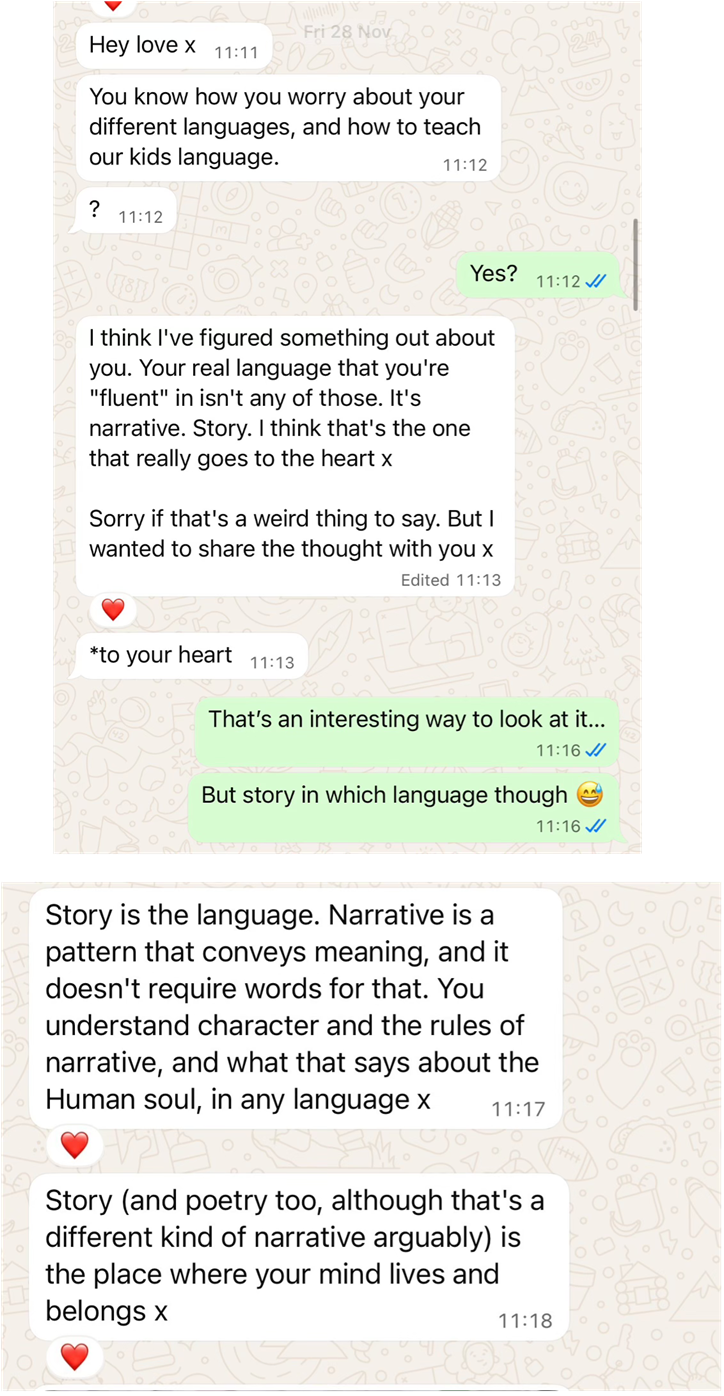
I think my husband understood something about me that I have been struggling to conciliate for years – the struggle of speaking three languages, of having three very different worlds in my mind, constantly, and not really knowing where I truly belong sometimes – I think this all finds a home in poetry.
This might be why I love these poems that defy the ‘rules of language’ so much. They speak my language.
Like other poets of his time, such as Apollinaire or the Oulipo poets, Cummings broke many rules of poetry writing. He shattered rhythm as well as syntactic, typographical, lexical, and grammatical conventions: his poems possess a great freedom – and that’s what attracts me to his writing.
His words are not imprisoned by any rules: they are free to express their full potential. And Cummings takes up the challenge of making poetic what had never been poetic before. I love his way of playing with words. And what I love is that to play with words, and to ‘transgress’ canonical forms, one must know them well – and master them, and we sense this in his poetry.
Breaking poetic conventions doesn’t necessarily mean despising them – I would even prefer to speak more of ‘transcending’ conventions than of breaking from them.
But – to bring this to an end because I could spend hours talking about poetry – here are three of my favourite poems.
The first (in English translation from the Portuguese) is another by Vinicius de Moraes, ‘Soneto da Fidelidade’, or, in English, Sonnet to Fidelity. Next comes a translation from the French, Poem for Lou by Guillaume Apollinaire. And finally, here’s one from E.E. Cummings, next to of course god america i
This is an article which was first published on Jaqueline Leftwich’s Substack ‘Books and Saints’. For other stimulating articles on language and literature by her, see here.

Jaqueline Leftwich
Jaqueline Leftwich is a book lover and coffee enthusiast. Born in Brazil, she grew up in France and holds an MA in English Literature (Sorbonne University). She taught French in the UK for a few years, but now works in admin and lives with her husband in the Midlands. She writes about books, faith, languages and the reading life on her Substack 'Books and Saints'.

