
“I don’t even think you’re real”: the embodied woman as mere spectacle
Mary Rose describes how women can feel when they are reduced in the eyes of some to their body.
Before I went to pilates, I tied my hair into two small ponytails. It was a decision so minor it barely qualified as a thought — elastic, twist, done.
As the elastic snapped softly into place, a memory surfaced with unwelcome precision: that same hairstyle, worn months earlier, under a much brighter sky.
It was summer. Just a few months ago. I was running along a beach path I didn’t know well, having chosen the more scenic island route without any real sense of where it led. I had my headphones in, music loud. The ocean lay to my right, glittering indifferently. At the bottom of the path, two men were sitting.
I didn’t hear them call out. I did not even know they said anything until I saw the movement — arms lifting, hands waving, the universal grammar of urgency. Something was wrong. That was without question. People wave like that when there is a big problem.
I slowed instinctively, already assembling explanations as I turned: maybe they need first aid and think I have it in this backpack, maybe they need a phone to call for help, maybe my water pack was leaking. What never occurred to me was that the waving itself might be the danger.
I jogged closer and pulled one headphone out.
Their voices finally reached me. They said that they really liked my hair like that. The comment hung in the air, unfinished, and for a moment I waited for what was meant to follow — the explanation, the emergency, the reason I was summoned over.
Instead, I was met with the scent, faint but unmistakable, of marijuana, and I noticed what I had somehow failed to see before: they were sitting there smoking. Relaxed, untroubled, exactly as people sit when nothing at all is wrong.
I told them — quickly, apologetically — that I’d thought something was wrong, that that was why I’d stopped, and that I needed to keep running. I took another step back, careful not to turn yet, as though that might be rude.
One of them laughed as if I’d missed a joke. The other leaned back and tried again.“Just come here,” he said. “Just for a second. Sit with us.” He paused, watching me carefully. Just come here. Sit with us. Stay. Just lie down. You’re not gonna give me a hug goodbye?
“Just lay down,” he repeated, as though the request were reasonable and my refusal unreasonable.
It was only then that I noticed how quiet it was. The path had curved away from the beach, and the trees pressed in close on both sides. I couldn’t see the ocean anymore. There was no one around. I had no clear sense of how I’d get back — only that the way forward did not feel like the way out.
I turned and ran, harder than before.
My heart was loud in my ears, not from the effort, but from the sudden, sickening understanding that my body, in ordinary motion and an ordinary hairstyle, was enough to invite this type of response.
I ran until I could see other people again. Then I stopped, and my body emptied itself there at the edge of the road, as though it had been waiting for permission.
The memory returned that morning with its familiar sickness. For a moment, my fingers hovered over the elastic, and I considered pulling my hair loose, as though that small undoing might send the past back where it belonged.
Read
That evening I sat at dinner with friends, several of them new to me. Midway through the conversation, one of the men looked across the table and said, “You look like you don’t support women’s rights. Can you speak on that?”
The sentence landed lightly, tossed across the table with a grin, as though it were a curiosity rather than an accusation. We had been talking politics, but only the usual subjects that surface, rights and responsibility and who is failing whom. Nothing I said had opened the door to this.
Earlier in the evening he had tried different questions. What did I dislike most about my boyfriend? What was my usual type? Each was delivered in the same tone — joking, ostensibly harmless — designed to see whether I would blush or oblige or make a game of it. Once, he began, “I just feel like you’re the type of girl who…” and then stopped himself, smiling, as though he had generously spared me whatever followed.
When I gave short answers and changed the subject, he sighed and said I was ‘no fun’. I let that pass.
I had asked him, in good faith, about his work. He was employed by a rights organization, and I wanted to know what they did, what cases they took, what had drawn him to it. His answers floated upward into generalities, self-satisfied and incurious, the sort that turn a question into a small performance. He did not ask me anything in return. Instead, he returned to me.
I didn’t defend myself to this stranger. I didn’t list my causes or credentials or offer up my beliefs for inspection.
I asked him instead what, exactly, about me had suggested that.
He shook his head. “I’m not answering that,” he said pleasantly. “I asked you the question.”
The refusal was instant, almost elegant. And in that moment it was clear that I had not been addressed as a person at all. I had been read. My appearance was treated as evidence, and when I asked what it said, the man doing the evaluating would not speak it aloud, as though the words were either too plain or too shameful to repeat.
Diminished
I left dinner unsettled, the exchange still echoing unpleasantly. On the walk to the car, a man called out from his window that I was beautiful. He added that he was ‘very gay’, as if to make clear that the words were not a prelude to anything else.
I laughed. It surprised me how good that felt. For a moment, I felt steadied by the reminder that being seen does not have to cost anything. I carried that small warmth with me.
It did not travel far.
On the last block to my apartment, another voice reached after me, asking where I was going, suggesting he might come along.
The earlier pride drained away, not dramatically, but completely. I unlocked my door with the familiar understanding that the distance between dignity and diminishment can be measured in steps.
It had been only a day. An unexceptional one. And yet, by evening, I felt faintly diminished, as though something essential had been passed over — noticed, perhaps, but not met.
Erasure
The following morning was quiet. I opened my laptop, answered a few messages, and paused over a comment on a post I had written some time earlier. I make a point of answering hostile remarks when I can. It is a practice I have set myself: to remain civil, to assume good faith longer than feels sensible, to learn not to let what strangers say about me settle into permanence. Deliberate kindness can be a way of keeping one’s footing.
I read and liked the comment as I always do, with the intention of answering plainly and without heat, and of leaving the exchange in better order than I found it.
A response appeared beneath my name. I read it once, then again.
I don’t even think you’re real.
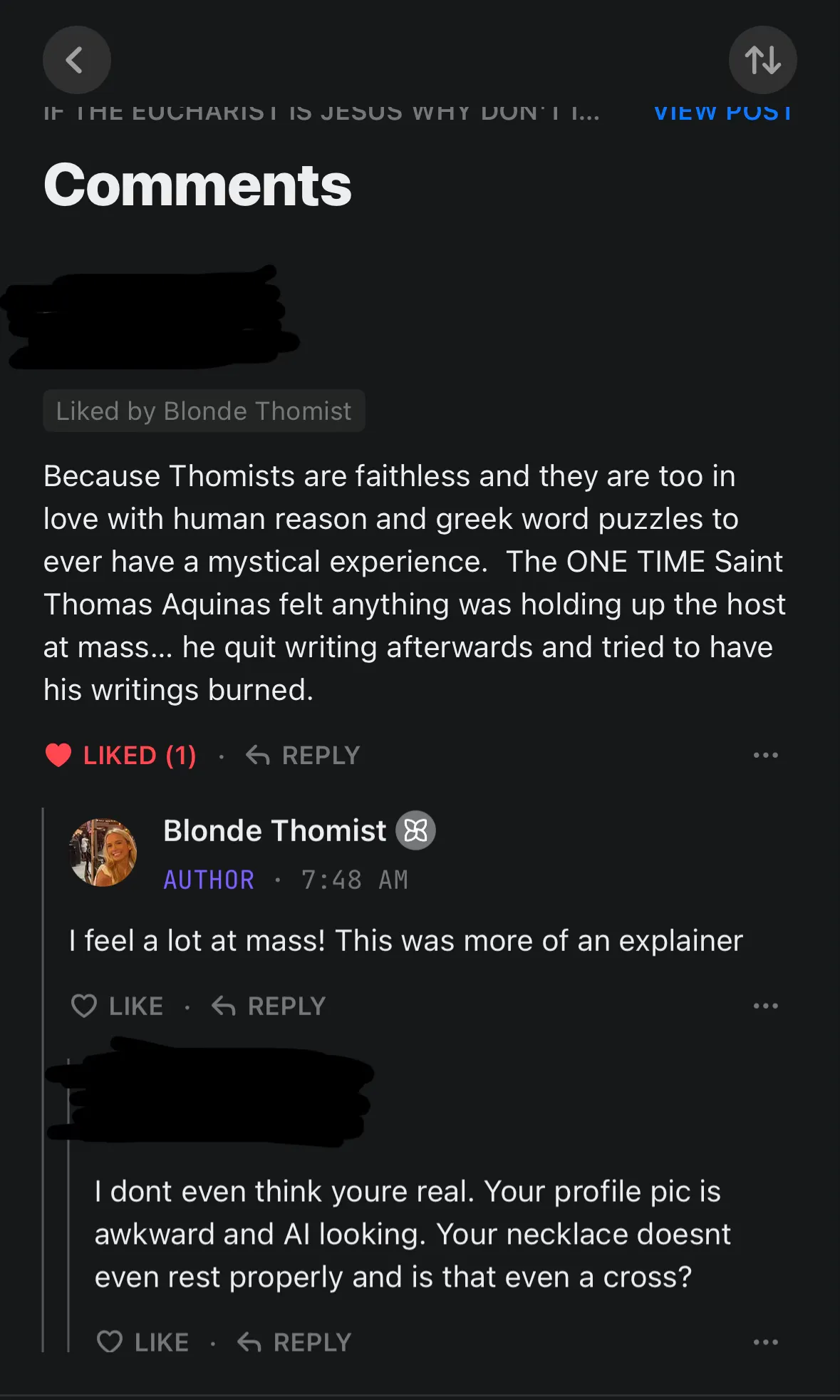
I looked at the screen for longer than I meant to. I waited for the sentence to alter itself, to pick up a trace of irony or exaggeration. It did not. It sat there, composed.
There was nothing charged about it. No anger, no emphasis. It had the calm finality of something said after consideration, not in haste.
I had met this logic already, though not yet in so few words. It was the same one I had met the day before, only pared down to its conclusion.
The body noticed on the path. The body assessed at the table. The body praised, mocked, waved over, dismissed. Each time, something other than I was being addressed.
And when the body failed to answer correctly — when it did not flirt back, justify itself, perform on cue — the verdict followed naturally enough.
What appeared on the screen was simply the most economical version of that process.
Not disagreement.
Not rejection.
Erasure.
I don’t even think you’re real.
In the previous day’s incidents, I had at least been granted a body. However poorly treated, it was still assumed to be there.
This time, the judgment did not need to pass through the body at all.
Every woman learns early that there is danger in both appearing and withdrawing. To be visible is to invite judgment; to disappear is to risk being forgotten.
However, the desire to be seen and known and loved is by divine design. We’re wired that way. It is the soul’s recognition that it exists in relation to others. A person does not wish to be stared at; she wishes to be acknowledged. She wishes to be met as something real.
Appraised
Women are then offered a false explanation. If attention wounds us, we should have avoided it. If invisibility wounds us, we should have wanted less. The desire itself is blamed. In truth, the disorder lies elsewhere.
The problem is not that women wish to be known, but that we live among people who have learned to look without loving.
To see rightly is not merely to register what is there. It is to acknowledge that what is seen has claims upon you, too. It has its own dignity. It deserves respect.
Without that acknowledgment, visibility becomes spectacle, and spectacle becomes a kind of unreality.
This is what makes the experience so disorienting. The same gaze that promises affirmation can just as easily revoke it.
A woman learns to approach attention cautiously, never certain whether she is being welcomed or appraised. She is encouraged to speak, to be present, to take up space — and then reproached for having done so.
What remains is an impossible tension. To withdraw entirely is to vanish. To step forward is to risk being made into an object. Both exact a cost.
And still the desire persists, because it is a good desire.
We continue to want what any human being wants: to be known, to be loved, to be met in our bodies rather than reduced to them.
We want a gaze that does not demand performance, that does not punish refusal, that does not confuse access with intimacy.
The modern habit of recording everything has only sharpened the problem. Images promise preservation, but they also invite possession. What can be captured can be judged, repeated, consumed.
The more complete the record becomes, the easier it is to forget the person who once stood behind it.
Spectacle
We live in a world that prefers appearances to persons. This preference allows us to look without being implicated and take in surfaces while remaining untouched by what stands behind them.
Spectacle is simply this habit perfected.
Spectacle does not deny the body. On the contrary, it depends on it. It requires the body to be present, visible, available for inspection. What it denies is the person who inhabits it.
The body is allowed to appear so long as it performs its function. When it ceases to do so — when it refuses, resists, or simply fails to interest — the person who inhabits it is quietly dismissed.
Women encounter this early because their bodies are so readily mistaken for explanations. A woman appears, and meaning is immediately assigned to her — about her intentions, her character, her worth.
A woman may be looked at continuously and yet never be met at all. Her appearance is treated as a sign that stands in for her person, and once the sign no longer communicates what is wanted, the person beneath it is no longer required. She is not argued with. She is not even rejected. She is simply removed from consideration.
This is why spectacle is so dangerous. It trains us to believe that seeing is sufficient, that recording is the same as attending, that an image can replace a reality. It flatters the viewer by relieving him of obligation. He need not respond, acknowledge, or love. He need only look.
But to see a human being rightly is not a passive act. It carries responsibility. It demands recognition of limits — limits on what may be taken, assumed, or consumed. Spectacle avoids these limits by substituting surface for substance and calling the exchange complete.
In such a culture, erasure is not the opposite of attention. It is its final form.
That is why a woman can pay the full cost of embodiment and still be told that she does not exist.
For other stimulating articles by Mary Rose, see her Substack Blonde Thomist. This article is re-published in Adamah Media with her permission.

Mary Rose
Mary Rose is an international law journalist based in San Francisco, California. She studied Law & Society alongside sports reporting for NBC at Purdue University, where she had an extraordinary encounter with the Eucharist and fell in love with her Catholic faith through campus ministry. Mary Rose has worked on communications and migration justice initiatives for the Church nationally and internationally. For fun, she writes about theology in art and culture on her Substack, 'Blonde Thomist'.

