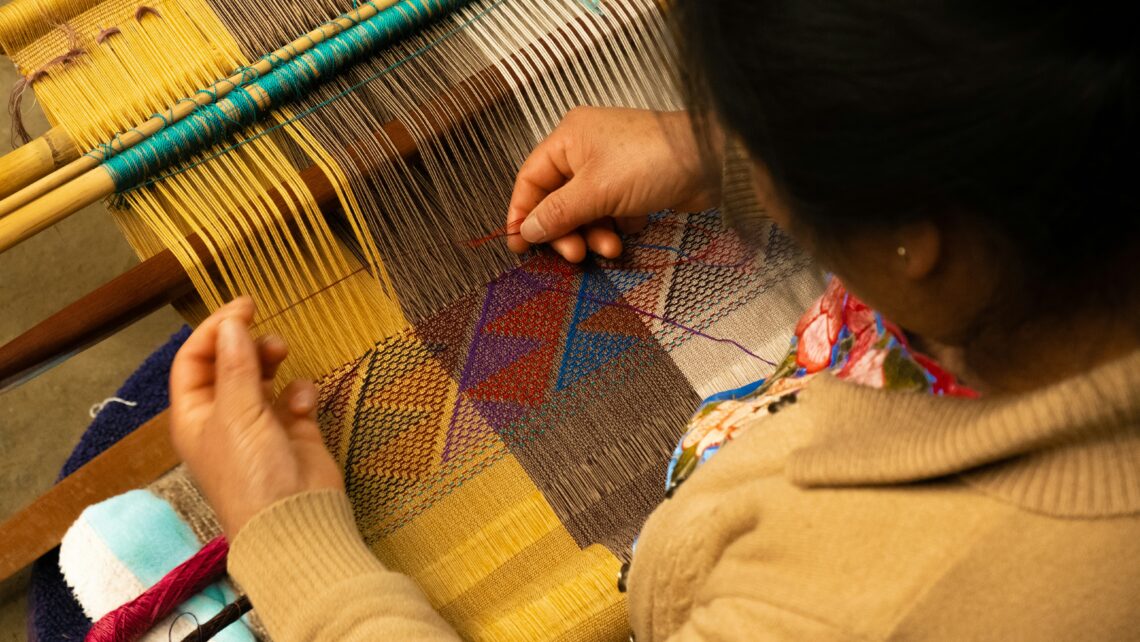
How our society came apart and how we can re-weave it
Jenny Sinclair names the delusion of the ‘unencumbered self’ as the root cause of our society’s crisis but believes it is still possible to remake our national and local communities.
I think it was Ernest Hemingway who said that change happens slowly, and then all at once. It certainly feels like that. Pope Francis said some years ago that ‘this is not just an era of change, but a change of era’. He said we’re going through a process of being ‘stripped of false securities’, where it’s no longer possible to enjoy complacently the illusions of the old era.
It is not credible anymore to continue with the assumption that governments can adequately represent us, nor that the socio-economic model we’ve been living with can underwrite a flourishing life for all.
So what do we see now?
We see extremes of inequality. We see estrangement between civic groups. We see commodification of creation. We see war, displacement of people.
We see the hyper-liberalization of abortion, assisted suicide – a huge shift in the understanding of human dignity.
We see the proliferation of social media exploiting the young. We see place – the local – being subordinated by the digital world. We see the acceleration of AI and the technocratic paradigm.
We’re beginning to see the collapse of trust in institutions.
We see ever more tribalism. We’re also seeing loneliness, especially among the young – statistics show that loneliness is much worse among the young than the old. We’re seeing a sense of nihilism and distress about meaninglessness.
When I was saying this ten years ago some thought I was exaggerating. Talk of unravelling was seen to be catastrophizing. But now, I think we can see what is happening. Notwithstanding the fact that healthy, normal life goes on, what you see depends on where you live, who you know, and what media you consume. We’ve become so fragmented now that our lives are in parallel.
False anthropology
Every era is shaped by an animating idea. The idea underpinning the era that’s now in the process of breaking down comes from the philosophy of liberalism. And it’s a particularly extreme strain of liberalism, stemming from the idea of the ‘unencumbered self’, where freedom is understood as freedom from constraint. Freedom from the constraint of family, of borders, freedom from history, freedom from God, freedom from natural law, freedom even from the very reality of our bodies.
This is where we are now. This is why you get to the point of people saying that it’s perfectly alright to have abortion up to birth. This is why you get people saying that it’s got nothing to do with you if I choose to kill myself, that it’s not going to affect you.
But does this really make sense? Surely, if someone takes an action, it’s going to have effects on everybody around them, everyone who cares for them, everyone they are in a relationship with. So, this idea of the unencumbered self is actually denying reality. But this is where we’ve got to.
This ideology is inherently unstable because it relies on a false anthropology – a desiccated, soulless conception of the human being as an isolated individual.
This generates a false idea of freedom and leads to a cult of self where everything revolves around ‘personal preferences’.
The culture has been dominated by the idea of ‘choice’. But it is not really choice. The false anthropology underneath this is so completely unlike Christian anthropology – where the person is a relational being made in the image of God. This philosophy goes against the grain of humanity.
Eventually, inevitably, it liberates society from truth and from mutual responsibility. Its spirit is anti-human: that is why the system is breaking down. That is why we see the unravelling. It is based on a relativistic and a materialistic logic that ultimately brings about its own destruction.
This misconception of the human being as an isolated, rights-bearing, competitive individual also led to the emergence of identitarian politics. This is why we get the distorted forms of victimhood and the culture wars. This has led to spiritual confusion and demoralisation.
It has also distorted the meaning of ‘social justice’. The conception of social justice now dominant is focussed upon identity and the ‘oppressor-oppressed’ dynamic. This is not the definition of justice from a Judaeo-Christian point of view.
Correctly understood, Judaeo-Christian justice is about relational justice. We can see this in the Old Testament: the rabbinical tradition of justice is about right relationship, not division. By contrast, the animating idea of the unencumbered self has eaten away at our shared values, has eroded our sense of citizenship, dissolved relationship, undermined the particularity of place.
Low wage economy
Not least, we can see that it had a huge impact on the economy. It broke the tradition of vocational jobs. In the process of ‘deindustrialisation’, jobs were offshored to the Far East; investment went abroad.
This was replaced by the knowledge economy and the service economy. The purpose of this profound change was to make a ‘frictionless’ environment for investors. It worked very well for them but it was devastating for many of our communities. It also sucked workers from poor countries, away from their families, to come and work for Western business models here on very low wages.
And so we end up with a low wage economy. But many wages are too low to live on, which is why in the UK, we now have nine million people on Universal Credit. That is up from 7.5 million just last year. This is completely outrageous from a Christian point of view. It is an affront to human dignity, not only that so many people are poor, but also that so many are without work, which creates a culture of entitlement.
The breaking of relationship with place has been devastating.
The idea of movement to find decent work is now supposed to be a great freedom. But of course, the reason this is happening is that the system of globalisation, which serves the interests of big business, requires a fluid labour market.

You will begin to see now that what I’m saying is coming from a tradition. This Catholic Social Teaching tradition is saying, “What is happening to human beings? What’s happening to families? What’s happening to communities? Are they thriving?” Answer, no. “Why is that?” It’s because the economy is structured in this way.
I would describe this whole state of affairs as a breach of a common good. Because communities that suffered at the hands of this dogma have not just been left behind. There’s also been no meaningful correction, no further investment, no retraining. It just hasn’t been done.
On top of that, those communities were then framed as deficient and backward. So we shouldn’t be surprised to now see a politics of discontent emerging. The impact on our common life has been quite devastating. As a result, we now have a breakdown of trust in the State – a huge problem that is now manifesting in our politics.
This hyper-liberal idea has infected both the left and the right. Both our main political parties became completely colonised by it: the Conservatives stopped conserving, and Labour stopped advocating for the dignity of labour. They completely changed their priorities.
There is a blind spot here, on both the right and the left: both the neoliberal economic model and hyper-liberal social norms are driven by the same logic, where limits are framed as regressive.
The right attributes moral unravelling to excessive liberalism, but somehow neoliberal economics gets a free pass. Meanwhile, the left attributes poverty to the neoliberal economic system, but embraces the progressive ideas of unlimited self-actualisation (for example, the idea that I can remake my own body, as if I’m God).
Both the left and the right – in different ways – are still captured by this progressive doctrine. And its effects are not only material. There are social and spiritual consequences too. Its culture of transactional individualism corrupts, commodifies and dehumanises. It has weakened the human person, family and community. It is effectively an assault on relationship.
Three sins
We ought also to broach the difficult subject of how 45 years of this hyper-liberal system has impacted the churches, whatever their specific denomination. There are lots of angles we could take here, and we haven’t got time to go into all of them, but let’s particularly look at the relationship of the churches with poor communities.
What’s happened? We could formulate this into three ‘sins’.
The first sin we can identify is the disconnect between charity and justice. For example, we continue to hand out food parcels whilst not challenging the socio-economic philosophy that generates poverty in the first place.
This sin is inadvertent, through great well-meaning and kindness, but it can mean that Christian charity can end up being part of the problem, propping up an unjust system.
This happens when we fall for the wrong kind of justice, a welfarist, utilitarian model, as opposed to a justice based on the dignity of work. The pursuit of that welfarist model masks prophetic justice: the more efficient we become as a service provider, the less likely it is that people will see the root of the problem.
The second sin is about encouraging dependency – again, inadvertently. Sometimes the ‘service-client’ dynamic in Christian charity encourages dependency and entitlement. It turns a person in need into a passive recipient, into a supplicant role. It also puts them in a transactional dynamic, where the benevolent giver is giving, and they are receiving. This is not a relationship of reciprocity, which is what we’re looking for if we want relational justice.
This sin also undermines solidarity, because what people who are poor really want is a job, the dignity of being able to support their own family. I know someone who puts it very crudely.
He says, “the church has become a woke food bank. What we really need is decent work, so we can make a life.”
Yes, decent conditions and a decent wage. Remember we have a low wage economy. This is something that international finance companies lobby governments to deliver. It is in their interests to keep wages low. This is one of the reasons for mass migration over recent years.
We can all have different opinions about that. I do not take a racialized position on this. I think it’s actually an economic issue. Successive governments of all parties have perpetuated this to keep wages low. And it has destroyed the social peace.
The third sin I wanted to draw attention to is secularisation – the disconnect with faith. Many Christian charities have become a little shy about being Christian. Perhaps they are worried they won’t get funding. Or perhaps they think it’s not cool anymore. Or they want to make the language on their website more ‘inclusive’, so they dumb down the Christian side of it.
Sometimes the original Christian charism that underpins a charity gets fossilised when its founding inspiration isn’t fostered, or when it’s neglected. For example, a charity may have been founded on a genuine charism at the beginning, and then over time the trustees change. The CEO is now very efficient and professional in the NGO world, but he or she is not a practising Christian, and so the values subtly evolve.
All this can compromise Christian distinctiveness so that the visible elements of Christianity become indistinguishable from a secular NGO. The system can also affect the way churches perceive themselves. Government voices may say, aren’t you wonderful? aren’t you useful. The transcendent meaning of Christianity is reduced to social usefulness.
Local governments may offer us money and we are flattered – we think, isn’t it great! But if we get too close to the system, we end up enabling the problem. I’m not saying we should stop doing charity. It’s essential. But we have to be prophetic, too. Christian charity must not become a handmaid to the State.
This same philosophy has also impacted the church in terms of moral leadership whereby Christian leaders might fear to speak out so as not to rock the boat or upset a cozy relationship with those in power or who control the funding.
This is a new era. New things are happening. We have serious geopolitical volatility – the end of the liberal world order, of the Tony Blair project to export democratic liberalism around the world. Many other cultures just don’t want this, they never wanted it and they’re angry about it. The dynamics have changed.
Meanwhile at home, domestically, we have a dysfunctional government. And we are facing a new industrial revolution.
Which revival?
Amidst all this we are seeing spiritual confusion. We are seeing signs both of what some people call a ‘quiet revival’ and what of some are describing as a ‘dirty revival’. The picture is mixed.
There seem to be movements of middle-class people attracted to more traditional forms of church – Orthodox, Catholic, Anglo Catholic. Many are fed up with being in a sea of meaninglessness, and are looking for something solid to attach to, and finding meaning through that.
Meanwhile there are widespread anecdotal reports of Christian movements among post-industrial working-class communities. Having experienced great loss, there is a yearning for identity. Disillusioned with the churches that have not delivered on their responsibility for moral leadership, they are reaching for Christian morality from non-mainstream sources. It may look rough to a middle-class sensibility, but something is happening.
Alongside this, we are seeing the political space becoming more religious, not less. We are seeing insurgent Muslim political movements, Hindu movements, various different types of Christian flavoured politics pressing through, being expressed. It is becoming a contested landscape.
The Christian response today
So, how are we supposed to respond?
The Catholic tradition is often described as both radical and conservative. It asserts the family, it asserts belonging to place, but it also asserts intervention in the economy – it doesn’t support the unrestricted freedom of movement of capital, for example – it recognises the danger that this can bring. It doesn’t map along the lines of the standard left-right axis.
I believe we need a Christianity which embodies the basic principles of Catholic social teaching, namely the dignity of the person, solidarity, subsidiarity, and common good.
We have to recognise that the cavalry is not coming over the hill. We can’t expect government anymore to adequately provide. Certainly not for a while, anyway. We’re in a very volatile period.
So, what do we do at the grassroots level? If we understand that the problem – which we diagnosed earlier in terms of hyper-liberalism – is effectively individualism, then how do we counter that? It’s hard work, but it’s not complicated.
The solution is about building relationships – intentionally building local relationships.
We can see, in the examples of inspirational Christians leaders like Sheppard and Worlock, Manning and Booth, that it is possible to have church leaders determined to build civic relationships for the benefit of the city – for the people.
It’s also about refusing to be tribal. We must build broad-based alliances with our neighbours. Our tradition regards the local church as an intermediary institution whose calling includes being outward facing and proactively relational.
We can start by asking “Who do we know? Do we know the pizza restaurant? that business? the Tenants Association? What relationships do we have?” We are called not just to build up our own community. Not just to be focussing inward, not just on this lovely space. We’re called to be an outward-facing people. To be a Jeremiah 29.7 “seek the peace of the city” type of people.
We should be resisting the identity politics that divides. We should be talking more about solidarity than diversity. “How can we work together? How do we find common cause with each other, even if we disagree on certain things?”
And we should be speaking the truth. Speaking the truth is very important in this new era. There’s too much self-censorship going on. We all know that sense, don’t we? Sometimes we’re like, “I can’t say that.” We may be afraid of what will happen. We resolve to keep quiet. Well, I’d suggest that next time you feel this, if you feel that prick in your conscience, you should speak – at least inject a note of doubt.
The antidote to this toxic individualism, finally, is relationship. There is something about building friendship in a proactive, conscious, intentional way.
If you see a group that’s vibrant and alive, that’s a beautiful thing. The common good is what happens between people, where together they create a sense of mutual flourishing. If you see that, encourage it. Support it, enable it to grow, connect them with another group. Be a part of the re-weaving.
This is an edited extract from a much longer talk given by Jenny to Churches Together Horsforth in Leeds in March 2026. For the full transcript of the talk, plus a recording of the talk and the Q & A, see here. This extract is republished in Adamah Media with the author’s permission.

Jenny Sinclair
Jenny Sinclair is founder and director of Together for the Common Good, a Christian charity dedicated to spiritual and civic renewal. Drawing on Catholic Social Thought, she works with leaders, churches and schools, helping them make sense of this time of seismic change and discern their unique vocation for the common good. www.togetherforthecommongood.co.uk

