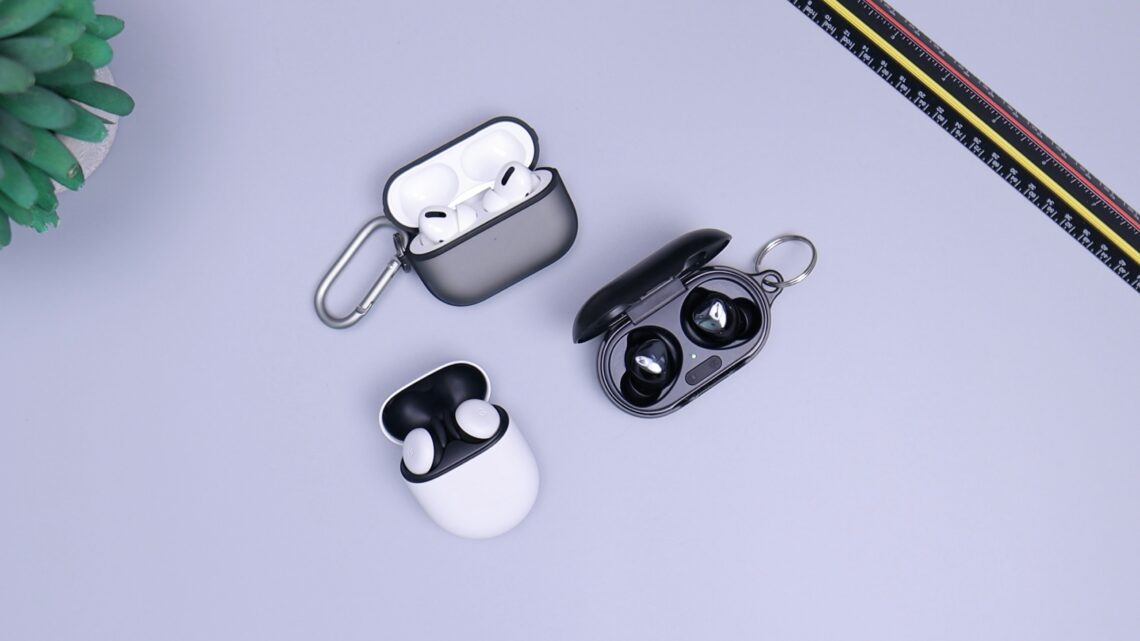
Earbuds on, human connection off!
Joshua Nwachukwu is concerned that an excessive use of electronic devices in his native Nigeria and beyond is cutting us off from other human beings.
Is anyone else concerned about this earbud/headset culture we’ve embraced? Almost everywhere you look, people have something in their ears. Many of us have our ears plugged in almost 24/7.
I come from Nigeria where people are naturally communicative and like to chat. But earbuds and headsets threaten to reduce us all to silence.
Whether we’re driving, walking, working, sitting in a lounge or waiting room, on a plane, on a bus, or shopping, we’re almost always plugged into something. In doing so, we leave very little room for spontaneous conversations or genuine human interaction.
The issue of driving is particularly interesting. It’s true that hooting isn’t common in more civilised places, but in a place like Nigeria, particularly Lagos, where one drives with all the senses on high alert, I always wonder how people drive while plugged in. Even more surprising is seeing people walking while plugged in and simultaneously watching videos on their phones.
The trend doesn’t stop there. Even in churches, meetings, and other social gatherings, people often keep one or both earbuds in.
A friend jokingly remarked that earbuds have become part of our jewellery, another accessory we put on before leaving the house.
As amusing as that sounds, there is some truth to it.
It’s becoming increasingly common to sit beside someone for minutes or even hours without exchanging a simple ‘hello’ or introducing ourselves. That doesn’t feel natural, and it makes one wonder how we drifted here so quickly.
A few years ago, that would have felt unusual. Today, it’s expected.
Perhaps it’s a by-product of extreme individualism and our growing emphasis on respecting personal space. I understand that not everyone is outgoing or enjoys meeting new people, and people deserve their intimacy.
But once there was once a balance between valuing privacy and remaining open to human connection. Now it seems we’ve moved from respecting boundaries to avoiding one another altogether.

Technology has made it easier to stay entertained and informed, and now we have unlimited access to music, podcasts, and content. But has it quietly taken away something just as valuable: the art of connecting with strangers, learning from chance conversations, and simply being present?
Noise-cancelling technology has only deepened the isolation. It completely blocks out the environment around us. Someone trying to get our attention or ask for help may have to tap us and not everyone appreciates being touched, especially by a stranger. As a result, we increasingly exist in our own private bubbles, a little world of me, myself and I.
I got a reminder of what we lose in those bubbles recently, while waiting for my luggage at the airport. The gentleman standing beside me was wearing a shirt with the words Latter-day Saints on it. Nothing about the moment demanded conversation, we could easily have stood there in silence, phones or earbuds in, waiting for our bags. Instead, I asked, “Are you a Mormon?”
He looked surprised and asked how I knew. “I read your shirt,” I said, smiling. That simple observation opened a wonderful conversation. I told him I had once visited the Mormon Temple in Utah and watched the Tabernacle Choir perform. Instantly, the exchange became warm and engaging; this connection would not have happened if either of us had been tuned out.
It reminded me that meaningful connections often begin with the simplest observations; when we’re actually looking up, ears and eyes open to whoever happens to be standing next to us.
This moment is exactly the kind of thing our earbud culture quietly edits out of daily life. And it’s mild compared to what can happen when that same openness meets a ten-hour flight.
Paul Onwuanibe, CEO of Landmark Group, tells a story which makes the point far better than I can.
He recounted flying to Texas for a friend’s wedding. During the ten-hour flight, he struck up a conversation with the passenger seated beside him. By the end of the trip, the man had offered him transportation to and from the wedding, gifted him matching ‘his and hers’ Rolex watches, and, more importantly, eventually invested in his business.
Onwuanibe used the story to illustrate the ‘strength of weak ties’, the idea that some of the people who may have the greatest impact on our lives are complete strangers we meet unexpectedly: on a plane, in a café, at an airport, or on a train.
The beauty of that story is that it wasn’t planned. He didn’t buy a first-class ticket hoping to network with wealthy people. He wasn’t looking for an investor. It was simply a chance encounter where serendipity rewarded openness.
Not every conversation will lead to a multimillion-dollar investment nor should that be the goal. Some conversations simply broaden our perspective.
I’ve met fascinating people on flights. On one occasion, I sat beside a professor of medicine, and our conversation gave me a deeper understanding of the history of Chief Medical Directors (CMDs) in Nigeria’s public teaching hospitals. I left the flight wiser than I boarded it.
Not everything has to be utilitarian. Sometimes the value of a conversation lies simply in learning something new, hearing another person’s story, or making a new friend.
I simply wonder whether we’ve become so accustomed to shutting the world out that we’ve forgotten what we’re missing. Have we sacrificed serendipity for convenience? Have we traded curiosity for constant consumption? And in our quest to remain permanently connected to our devices, are we becoming increasingly disconnected from one another?
Beyond the social implications, there are also health questions worth considering.
What are the long-term effects of wearing earbuds for several hours every day, especially at high volumes? Hearing specialists have repeatedly warned about the risks of prolonged exposure to loud sounds and have proposed the 60-60 rule for safe listening: keep the volume at a maximum of 60% and listen for no more than 60 minutes before taking a break.
I also wonder whether there are cognitive implications. Today, many of us listen far more than we read. Podcasts replace books. Videos replace articles. Audio summaries replace deep reading. While listening is valuable, reading activates the brain differently. It engages visual processing, imagination, concentration, and critical thinking in ways that passive listening often does not.
Mark Twain famously said: “The man who does not read has no advantage over the man who cannot read.” One might adapt that thought to our digital age: if those of us with the ability to read increasingly choose not to, then we may gradually lose some of the cognitive benefits which reading uniquely provides.
I’m not suggesting that we abandon earbuds or reject technology. They have transformed the way we work, learn, and travel, and I use them myself. But perhaps the occasional silence has become underrated.
Not every journey needs a soundtrack. Not every waiting room requires a podcast. Not every flight needs to be spent behind noise-cancelling headphones.
Sometimes the greatest value of a journey is not what we consume through our devices, but who we encounter along the way.
History, careers, friendships, business partnerships, and even marriages have begun with nothing more than a simple ‘hello’. Those opportunities rarely announce themselves in advance. They arrive disguised as ordinary moments and ordinary people.
The irony is striking: we have never been more connected digitally, yet many of us have never felt more disconnected from the people sitting a few inches away.
Perhaps the next conversation that changes your perspective, your career, your faith, your business or even your life isn’t waiting in your playlist. It may be sitting quietly beside you on your next flight, in the airport lounge, at the bus stop, or in the seat next to you at a public place.
The question is whether you’ll ever hear it.
So, by all means, enjoy your music, your podcasts, and your audiobooks. But every now and then, take the earbuds out. Leave a little room for silence, thinking, contemplation and curiosity.
Leave some space for serendipity because, if you don’t, you will never know who or what you’ve been tuning out.
Joshua Nwachukwu is a lawyer and writer, can be reached at nwachukwujo@gmail.com

Joshua Nwachukwu
Joshua Nwachukwu is a legal practitioner based in Lagos, Nigeria. He currently serves as the Managing Counsel of Dictum Solicitors, a commercial and corporate law firm. Joshua sits as secretary on several boards and volunteers with several organisations, under whose auspices he advocates on issues of human dignity, human rights, education, and religious freedom. He holds an LLB from the University of Nigeria and an LLM from Strathmore University, where he was a Mandela Institute for Development Studies (MINDS) scholar. Joshua is also a writer and contributes frequently to national dailies in Nigeria.

