Defending religious freedom: why Article 18 matters
Elliott Banks describes how a visit to Christian and Yazidi communities in the wake of Islamic State’s brutal 2014 invasion of the Nineveh Plains helped him understand why religious freedom should never be taken for granted.
The Universal Declaration of Human Rights was a truly global endeavour. Forged in the aftermath of the Second World War, it sought to create a definitive statement of the rights and freedoms that belong to every human person.
Led by the former First Lady of the United States, Eleanor Roosevelt, the drafting committee brought together diverse cultural, religious and political perspectives from around the world. The result was a declaration whose 30 articles protect fundamental freedoms, from the rights to property, a fair trial and peaceful assembly, to Article 18: the right to freedom of thought, conscience and religion or belief.
Yet Article 18 is too often overlooked. While 78 per cent of constitutions worldwide explicitly guarantee equality or non-discrimination on the grounds of religion or belief, constitutional protection does not always translate into freedom in practice.
That matters because Article 18 is not simply one right among many. It is the foundation upon which so many other freedoms rest. The ability to believe, not believe, worship, change one’s faith, or express one’s convictions without fear speaks directly to human dignity. When that freedom is denied, other rights quickly come under threat.
Pope Leo captured this powerfully in an audience with Aid to the Church in Need ahead of the launch of our latest report on religious freedom. He said: “Religious freedom, therefore, is not merely a legal right or a privilege granted to us by governments; it is a foundational condition that makes authentic reconciliation possible. When this freedom is denied, the human person is deprived of the capacity to respond freely to the call of truth.”
It was during a delegation to Iraq, investigating the status of religious freedom 12 years after Islamic State’s brutal invasion of the Nineveh Plains in 2014, that I came to understand the profound importance of Article 18.
We met members of Iraq’s minority religious communities, many of whom are now concentrated in the country’s north, in the Kurdistan Region.
In the wake of ISIS’s campaign of terror, the Kurdistan Region became a sanctuary for religious minorities, including the many Christians forced to flee Mosul.
The Christians I met spoke of the fear they felt as Daesh advanced on their city. Among them was Archbishop Nicodemus of the Syriac Orthodox Church, who served as Archbishop of Mosul at the time and was one of the last clergymen to leave. The caretaker of his church was murdered by Daesh.
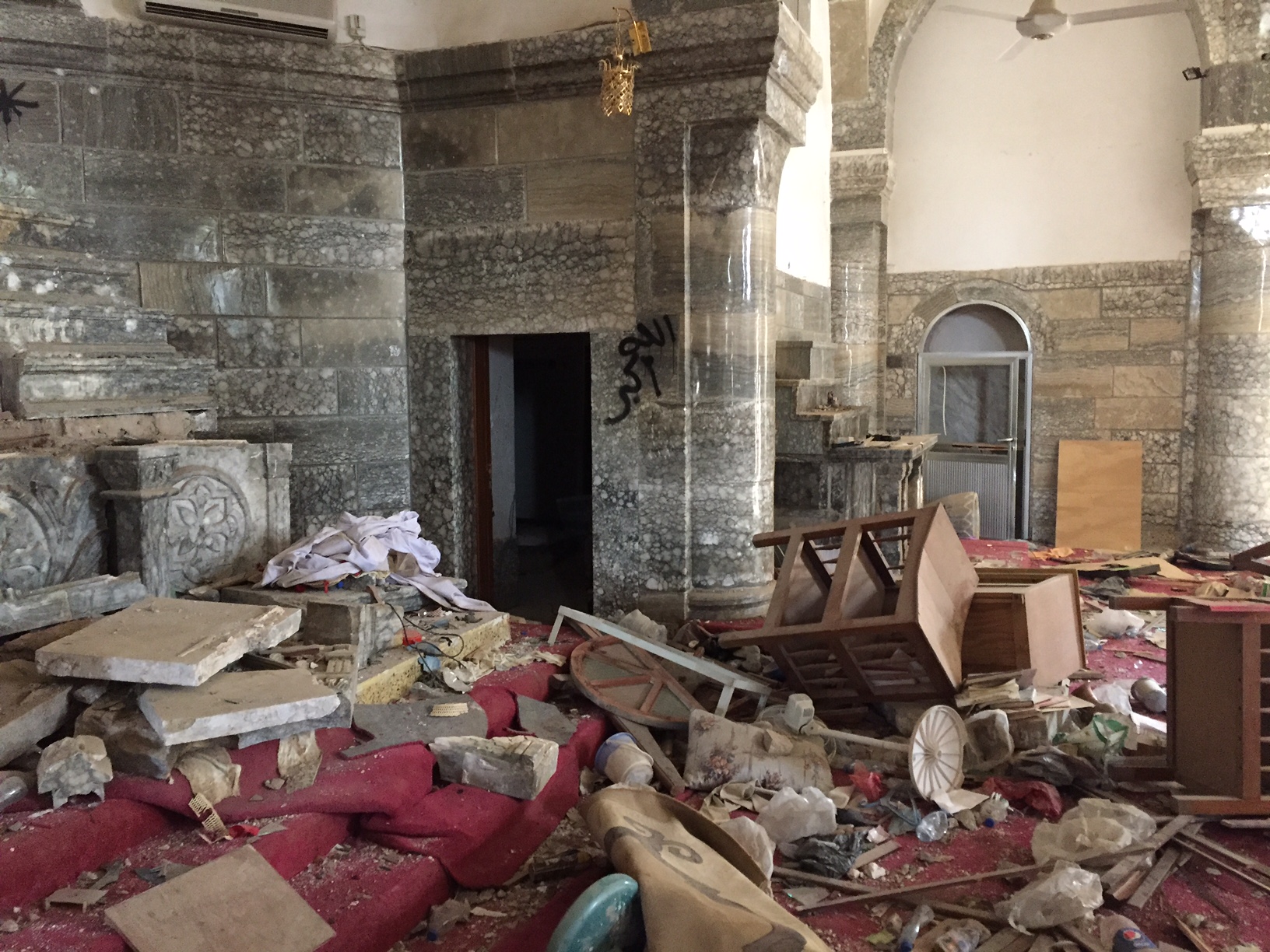
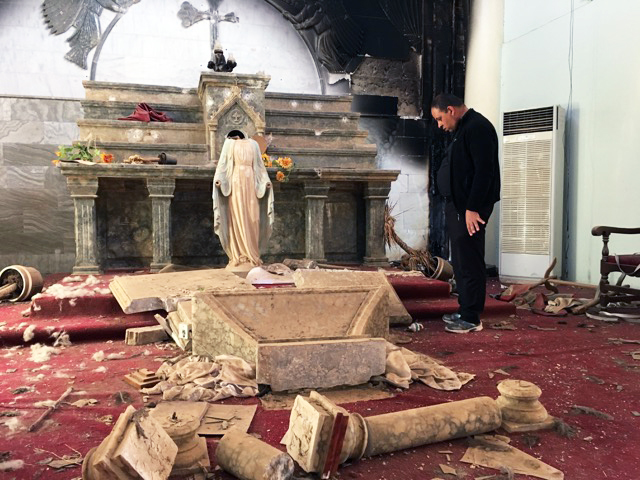
Damage caused by ISIS in the Nineveh plains in 2016
Other Christians told me how neighbours they had lived alongside for decades suddenly turned on them. One Christian couple returned home as ISIS approached only to find their house occupied by the very neighbours they had known for 30 years. The justification was chillingly simple: you are not of our faith; therefore, we can do this to you. Having lost everything, they fled behind the Peshmerga lines into the Kurdistan Region.
Yet it was a meeting with members of another persecuted community that truly opened my eyes to the evil of religious persecution.
In a small boardroom in Duhok, I met Yazidi survivors of Daesh’s atrocities and listened to their continuing struggle for justice.
Among the many painful testimonies shared that day, one account has stayed with me. It was the story of a young man not much older than I was.
When ISIS came to Sinjar, a historic heartland of the Yazidi people, he was just 16 years old. He described how the men of his village were rounded up and ordered to convert to Islam. He watched his father being shot against a wall. He saw his home set ablaze. He heard the insults directed at his family because they were deemed ‘non-believers’ and ‘devil worshippers’. Then he himself was shot and left for dead in a mass grave.
Miraculously, though badly wounded, he survived by playing dead until the extremists left. He crawled from the grave and made his way towards safety. Eventually he found his siblings, frightened and alone, higher up the mountain.
I will never fully comprehend the horror that young man experienced that day: the destruction of his community, the murder of his family, and the hatred that motivated those responsible.
And why did it happen?
Because of an ancient hatred directed towards his religion.
In the slave markets of Mosul set up after the triumph of Islamic State, Yazidi women and girls were sold to jihadist fighters as sexual slaves.
The attempt was clear; it was to destroy the Yazidi community – a religion that had survived in the Middle East for thousands of years.
The UN, EU and UK have all recognised this campaign of terror against the Yazidis as a genocide. At least 5,000 Yazidis were killed, around 10,500 women and girls were trafficked, and 92 mass graves have been identified. Even today, some 2,500 Yazidi women remain missing.
At its core, this genocide was an assault on Article 18. It was an attempt not only to kill people but to erase a religion, destroy a culture and extinguish a community’s right to exist. When freedom of religion or belief disappears, persecution follows. In its most extreme form, it can culminate in genocide.
Yet despite the bleakness of these encounters, I was struck by something else: the resilience of the human spirit and the enduring power of belief.
Today, in Ankawa, the Christian suburb of Erbil, Christians and Yazidis live in relative safety and peace. Attacks on Christians are rare.
During our visit, I met the Prime Minister of the Kurdistan Region, Masrour Barzani, who has committed his government to promoting tolerance and coexistence. He has even established a prayer breakfast bringing together different faith communities as a visible demonstration of interfaith cooperation.
The Kurdistan Regional Government’s Minister of Religious Affairs is also taking action against extremist hate speech, including dismissing clerics who promote division and intolerance. The testimonies we heard throughout the delegation reflected genuine efforts to uphold and protect religious freedom.
What my experiences in Iraq demonstrated is that this human right can only flourish when it is actively protected. Religious freedom is not passive. It requires laws, institutions and political leadership that recognise the equal dignity of every person, regardless of their faith or beliefs.
Article 18 is therefore far more than a statement of principle. It is a safeguard against discrimination, persecution and violence. It protects the space in which people can live according to their deepest convictions. It is also a cornerstone of wider human rights. If people cannot worship freely with others according to their faith, then freedom of assembly is weakened. If they cannot express religious beliefs without fear, freedom of expression is diminished. Article 18 should never be viewed in isolation. It is an integral part of the wider human rights framework.
The Kurdistan Regional Government demonstrated an important lesson to all of us on that delegation:
if you want religious freedom to endure, you must actively work to preserve it.
That is why Aid to the Church in Need has launched a campaign centred on the importance of Article 18.
It is ACN’s first international campaign and calls on governments and international institutions to redouble their efforts to ensure that freedom of religion or belief is defended with the same determination afforded to other fundamental rights.
Those of us who advocate for religious freedom often describe it as the canary in the coal mine of human rights. When Article 18 begins to erode, the weakening of other freedoms is rarely far behind.
The campaign has already received significant support from people across the UK, representing a wide range of faiths and traditions. It has been endorsed by both the Catholic Bishops’ Conference of England and Wales and the Catholic Bishops’ Conference of Scotland. Support has also come from the Anglican Bishop of Winchester, Philip Mounstephen, and the Coptic Orthodox Archbishop of London, Archbishop Angaelos.
Article 18 is not a privilege granted by governments. It is a universal human right. My experiences in Iraq showed me what happens when that right is denied, but they also demonstrated what is possible when societies choose tolerance, coexistence and respect.
That is why Article 18 matters.
You can find more information about the petition here.

Elliott Banks
Elliott Banks is the Parliamentary and Public Affairs Officer for Aid to the Church in Need (ACN). With a background working in Parliament and political campaigning, he is constantly looking for opportunities to raise the profile of religious persecution with key policymakers and ACN’s Parliamentary supporters. He read History at the University of York, specialising in British political and economic history.
