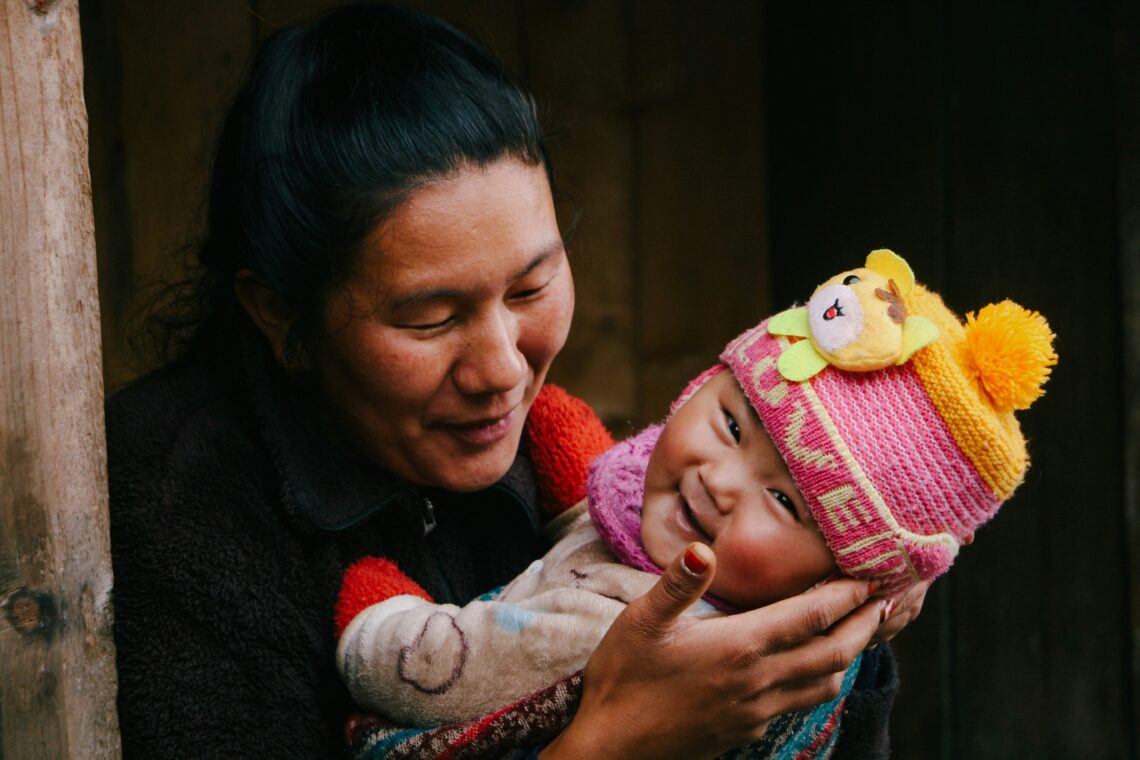
“Society needs to appreciate more what a social good motherhood is.”
A new research project is seeking to explore how radically motherhood affects society. Joseph Evans found out more.
‘Motherhood is both personal and profoundly political’ and involves ‘asking questions about life and death, the nature of care, gender roles, embodiment, sacrifice, autonomy and love’.
So believe the promoters of a new 18–month research project which seeks ‘to uncover the spiritual, social and political impact of becoming a mother’.
As the article introducing the project explains, motherhood is “the arena in which new citizens are formed, while relationships are re-negotiated and transformed … As countries face up to falling birth rates and the challenges of an ageing population, individual and familial decisions about motherhood and childcare take on global significance.”
Becoming a mother, or to use the more technical term matrescence, brings with it major physical, emotional and psychological changes in any woman’s life. It is ‘where women leave the public world of work for the private work of childcare’.
The article quotes from an online survey of UK mothers from October 2023 which found that ‘nearly three quarters of mothers felt “invisible”, while 93% felt unappreciated, unacknowledged or unseen once they’ve had children.’
Yet motherhood is the most essential reality for the continuation and flourishing of any society.
The project is the brainchild of the religion and society thinktank Theos in coordination with the Bible Society and came about in part because of the lived experience of its own staff members.
As one of the researchers on the project Dr Marianne Rozario explains, “some of our team members were themselves having their first children and began to ask themselves deeper questions about what motherhood means for them and what it might mean for society.”
What sort of deep questions? I asked. “Well,” answers Marianne, who is Theos’ Senior Researcher and Projects Lead, “the spiritual aspect of motherhood often isn’t talked about but it raises a whole series of existential questions attached to that space of life. We’ll be asking mothers whether motherhood has added meaning to their lives, has it given them a sense of wonder and awe, joy and peace, connection, a greater sense of the transcendent.”
The project, which began in late 2024 and whose research findings will be published in the spring of 2026, has two major components. The first phase is an in-depth case study of new mothers in the UK and involves interviews and focus groups with pregnant women and recent mothers.
In the second phase, the researchers will conduct smaller comparative studies, drawing on data in some other countries to help put the UK results in a wider context.
Research interviews begin with questions surrounding maternal care and are already coming up with interesting answers. When asked what they think about the information and care they received, both pre-birth and then post-birth, mothers have signalled the need for better information about breast-feeding, about how midwives frequently change, and about how post-natal visits can sometime be a mere tick-box exercise.
Many interviewed mothers have also flagged up the sheer expense of child-care cost. “Society is making it very expensive for parents to have children,” says Marianne.
The women interviewed thus far have also reported facing all sorts of pressures linked to pregnancy and motherhood. As Marianne explains: “They ask themselves questions like ‘will I be judged by my work if I tell them I’m pregnant?’ There can be a certain social pressure, even prejudice, against getting pregnant.”
Yet the project doesn’t want to limit itself to problems but also hopes to focus on the many positive aspects which motherhood brings with it.
“We hope the project will bring out the joy of motherhood. Perhaps society is not managing to show this enough.”
Is motherhood threatened by the idea that women can only fulfil themselves outside their home? I ask. And how do we balance the rightful desire of women to bring their many talents to bear in the professional world for the good of society with the strong desire of many women to be mothers?

“There are real tensions here,” answers Marianne, “which have already been highlighted by mothers surveyed thus far. And it leads to very practical consequences: is maternity pay enough? Does it reflect the worth of mothers?
“And then mothers returning to work can feel pressurised to perform to make up for time off. Yet with motherhood, priorities change. For example, career success might no longer seem so important.”
The way our society is structured makes it difficult for women to choose motherhood and modern working practices often mitigate against it. “Mothers ask themselves: can I financially justify to stay at home?” says Marianne. “Society needs to appreciate more what a social good motherhood is.”
The research project will also investigate the role which supporting communities can have. “These might be local, family or faith communities,” explains Marianne. “Where do mothers go for support? Intergenerational support can be very helpful in churches, for example through a grandmother figure even if she is not the actual grandmother. People crave that support. Mothers seek other mothers to journey with.”
Even a phone conversation with someone who has had a child can be invaluable, says Marianne. And though mothers naturally look for information and the experience of others on social media, this, she says, can be both good and bad.
I mention the idea of the deceased former Chief Rabbi of the Commonwealth, Lord Jonathan Sacks, who said that childbirth was very much an act of faith. One needs faith in God, or some form of faith, to be ready to bring children into the world.
“We can definitely see how faith can help new mothers, be that by faith communities supporting mothers through mums and tots groups or through faith allowing mothers to better grapple with questions that may arise about the meaning and purpose of life,” answers Marianne.
Let’s go back to that population decline mentioned in the article. Why is it happening and would supporting motherhood help to arrest the demographic implosion faced by many countries?
There are various reasons, thinks Marianne. People are choosing to have children a lot later, though again this begs the question ‘why?’. The reality is that the feminist movement over the decades has led to great strides in women’s equality, particularly in the workplace. So – unlike in previous generations when having children was a given – it is now much more of a choice.
There is a great stress on fulfilment through one’s career and motherhood is portrayed too much in terms of loss, sacrifice and non-fulfilment.
Isn’t a survey from Theos and the Bible Society going to be skewed by a strong Christian bias? I ask.
“We’re aware of that danger,” says Marianne, “so we have intentionally made sure that interviewees are not just Christian, but come from a wide range of faith and non-faith backgrounds. For example, we’re hoping to form an interfaith focus group, as well as to reach out to ‘religious nones’ – those who perhaps would define themselves as non-religious but have a complex and sometimes counter-intuitive relationship with spirituality.”

And, likewise, fathers will not be ignored either. “One question raised by mothers we’ve spoken with is whether current paternity leave is sufficient, and what that means for the support the mother receives.”
The article introducing the project quotes the writer Lucy Jones as saying that motherhood is ‘the most socio-political experience of my life’. Why do you think she says this? I ask Marianne.
“Because motherhood has so many social aspects. There are many dynamics attached to motherhood, based on how mothers influence their children, how they help to form and structure society, and so much more.
“Motherhood has so many aspects to it yet it is often looked down upon. Mothers don’t get paid for the care they provide in the house. And in a society where you are often valued according to how much you are paid, motherhood can therefore seem of less value.”
That, I suggest, is the paradox and a question which still needs addressing. How do we help motherhood receive the social recognition it deserves when in so many ways its very essence is that it eschews this and is love which only seeks to give? At the same time, motherhood also receives love, it doesn’t only seek to give it – so there’s a reciprocity in the mother-child relationship.
For what makes motherhood unique among all other human realities is that, at its best, it is love given freely, without any charge or bill. But maybe when the report comes out in the spring of 2026 we will have more insights to understand this better.
Like what you’ve read? Consider supporting the work of Adamah by making a donation and help us keep exploring life’s big (and not so big) issues!

Joseph Evans
Fr Joseph Evans is a Catholic priest and a member of Opus Dei. He has worked as a journalist and youth worker, and is currently a university chaplain in Oxford. He is co-founder and Editorial Director of Adamah Media and a poet. His most recent work, “When God Hides”, was published by SLG Press in 2025.

