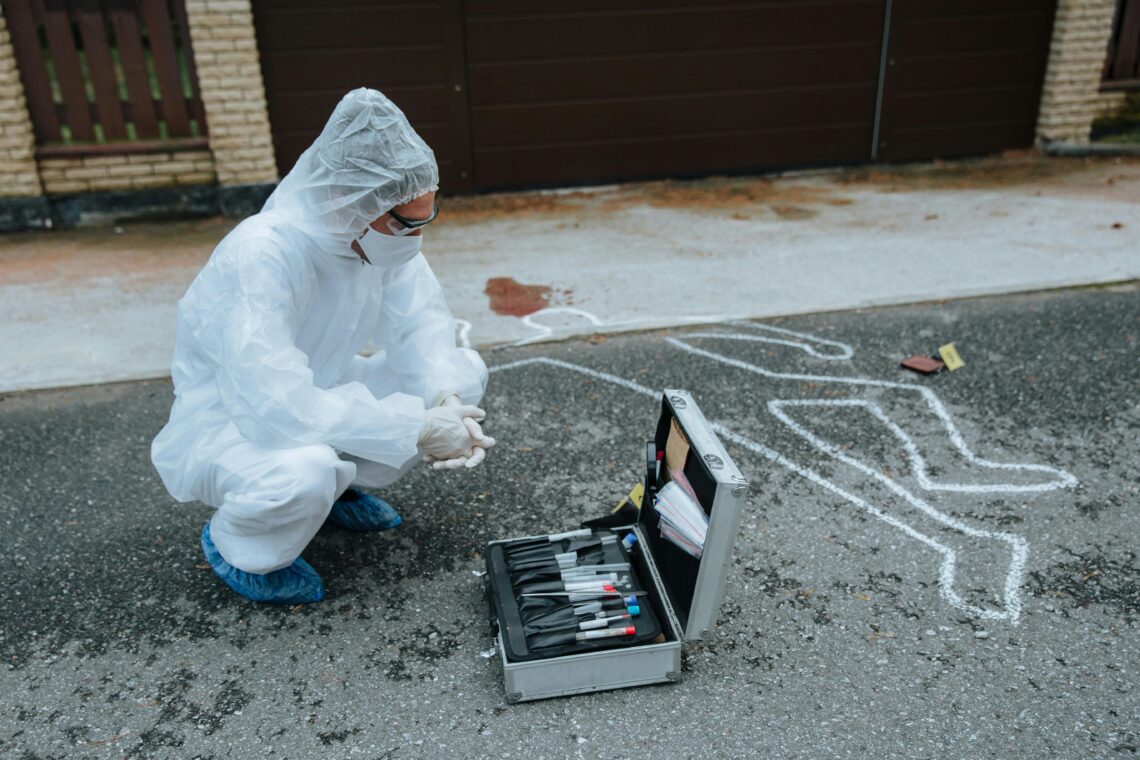
To be or not to be… Should I follow a life of crime (investigation)?
Yana Laszcziw struggles to discern whether she wants to spend her life in the footsteps of criminality and evil.
Say the term ‘Crime Scene Investigator’ (CSI) and Abby Sciuto, the Goth sleuth from the television series NCIS, might immediately jump to mind. The slightly older may instead think of Sherlock Holmes making the catching of crooks seem simply ‘elementary’.
Either way CSI sounds like an exciting and mysterious career path, uncovering key clues to track down foul felons. But is this the case or have literature and the media cast a shimmering filter over the often mundane reality of the job?
The question certainly matters to me as a soon-to-be Forensic Biology graduate. Do I want to work in this field? Will spending my days dealing with crime help me to become the morally upright person I want to be? Won’t all these dastardly deeds drag me down, at least to cynicism? Is this an appropriate career route for a religious believer?
Or, at a more mundane level, is the job all it’s cut out to be? I fear it may involve a slew of dull procedural chores, as many roles are becoming nowadays.
On all these questions the jury is still out. Or perhaps better said, the matter is still ‘under investigation’.
To help me with my decision-making, I spent some time with CSI Davidson – or just Suzi to friends and family, as she actually does have a life outside of crime investigation – to get an insight into her daily work.
With over 30 years as a CSI, Suzi works within the Merseyside Police but has previously worked within the College of Policing and the Cheshire Constabulary.
I wanted to know whether I was seeing the CSI world through rose-tinted glasses. And, my, have they been tinted from an early age.
My initial desire to study such an uncommon degree at university stemmed from an interest in adventure and mystery books as a child. Enid Blyton’s Famous Five books engaged my brain in a way other stories simply could not; perhaps my craving to solve problems and find the most effective solutions played a part.
I soon graduated to reading thriller writer James Patterson’s bestsellers and watching investigation programs in my spare time. I looked into unsolved case files and kept an eagle eye on current news stories.
Once the time came to apply for university, I thought the forensics route would provide me with a stable background for detective work, so I applied and was accepted to study at the University of Chester. Having studied crime scene investigation approaches and taken part in mock scene examinations during my time there, I have come to at least one conclusion:
the criminal world looks very different from behind the cordon tape than it does in front of a television screen.
To acquire more experience, I spent an afternoon with the Merseyside investigative team last summer, getting the lowdown on the real world of crime. At a glance, the team looked like any regular office force, occupied replying to emails and connecting with other police departments.

According to Suzi, a day in the life of a CSI is both challenging and varied, with no two working shifts the same. As CSIs are often consolidated into larger teams and are less widespread across every station, they can be deployed efficiently, with advanced technologies in tow.
The nature of the job means that CSIs may be called to work at any time of day, often requiring commitment to late night shifts or short notice operations.
This ‘on-call’ availability is not as glamorous as some television characters make it seem – not everyone is content to cancel their bank holiday plans to attend a last minute incident scene. And even Hercule Poirot wouldn’t have been happy to hear that his annual leave had just been cancelled because of some ghastly felony needing investigating!
CSI Davidson warned of the job’s psychological effect, admitting that her sense of humor and view of the world were altered after time in the role.
This seems only natural given the scenes CSIs attend on a daily basis, though it does beg the question: is the role worth the psychological disturbance which can accompany it?

And would I have to be like Abby Sciuto to qualify for the role? (For information, CSI Davidson seems much more ‘mainstream’). Must I also have pigtailed hair and tattoos all over my body?
There is also a real sense that Abby is in the world of crime investigation to help her come to terms with issues in her own life. Though one thing that does appeal to me about her is that she is depicted as a practising Catholic, as I am too. So religious faith doesn’t have to be an obstacle to entering the field. At least not in the televised version of the role!
But I still ask myself, is this career appropriate for a religious believer? Surely, having a front seat for the cleanup of some truly inhumane acts might make those of faith question their convictions.
But in some ways, faith might also help. Being so physically close to the deceased is uncommon for most, making them uncomfortable when faced directly with the aftermath of death. Yet my faith leads me to believe in death as a step to eternity, where divine justice comes into play even when human justice fails. And of course I can pray for both victims and perpetrators, drawing on a spiritual resource which non-believers do not have access to.
And then how would I feel knowing that the information I provide might be the key factor in deciding whether someone is freed or goes to prison?
The input of a CSI is vital throughout the course of enquiry and their testimony may hold the information that tips the scale towards a ruling of guilty or not guilty.
Yet as a Christian I believe in divine mercy, also on earth. How would I feel providing the evidence which leads someone to go to prison when perhaps in my heart I think they should be given another chance?
And yet balancing that is the sense that for those found guilty in court, prison can be an opportunity for reform. And appropriate punishment, as well as being a question of justice, can also act in favour of a person’s character.
Would my religious faith impair the exercise of my work? Some people would claim this. Yet I believe that my faith would only help me to adhere to the highest religious and ethical standards. The sense of honesty and the determination to seek the truth which my faith provides can only be a plus.
People must have the autonomy to adhere to the highest professional standards while respecting their own religious beliefs. After all, the role of the CSI is to objectively report their findings from scenes of crimes in a court of law; the only subjective part of the role lies within interpretation of ambiguous evidence.
Decisions, decisions, decisions. I’m praying to God for light to make the right call. And yet, I know that Christian presence in the world of crime is a good thing, somehow redemptive. Didn’t Our Lord Jesus take upon himself all our sins and crimes? Are not his disciples therefore also called to bare some of his burden with him?
Like what you’ve read? Consider supporting the work of Adamah by making a donation and help us keep exploring life’s big (and not so big) issues!

Yana Laszcziw
Yana Laszcziw is a soon-to-be graduate from the University of Chester, now based in London. She resides within the world of not-for-profit work, and is always on the look out for her next adventure, in work and beyond.


One Comment
Karolina
I like the questions raised by the author. It’s definitely useful to spend some time with a professional of the trade. I guess it’s important to separate work and everyday life otherwise the sadness of crime and injustice might bring one down.