
“There’s no way of one making sense without the other”: why faith and science should be friends not foes
Oxford epidemiologist Bernardo Gutierrez is not impressed by claims of a conflict between faith and science. In this interview he tells Adamah Media why.
Tell us a bit about yourself: your background, your current research…
I am a research fellow in the University of Oxford, in the Department of Biology, and a member of the Pandemic Sciences Institute. I studied biotechnology in Ecuador, then did a Masters in Edinburgh University in quantitative genetics, and a doctorate in Oxford in virus evolution. My current research is on how epidemics start and spread.
As both a scientist and a religious believer yourself, do you see there being a conflict between faith and science? If so, need there be one? Can they be friends? How can science contribute to faith and how can faith contribute to science?
I understand why people could find a way to create a conflict, because I had the same mentality in my late teens and early adulthood. But in fact, the reality is quite the opposite. There’s no way of one making sense without the other. Yet this requires the maturity to see both in a balanced way. The confusion arises when one gives absolute value to either and tries to use one to explain or do things which they are not supposed to.
Would we be helped by appreciating the different methods of faith and science? How do these differ?
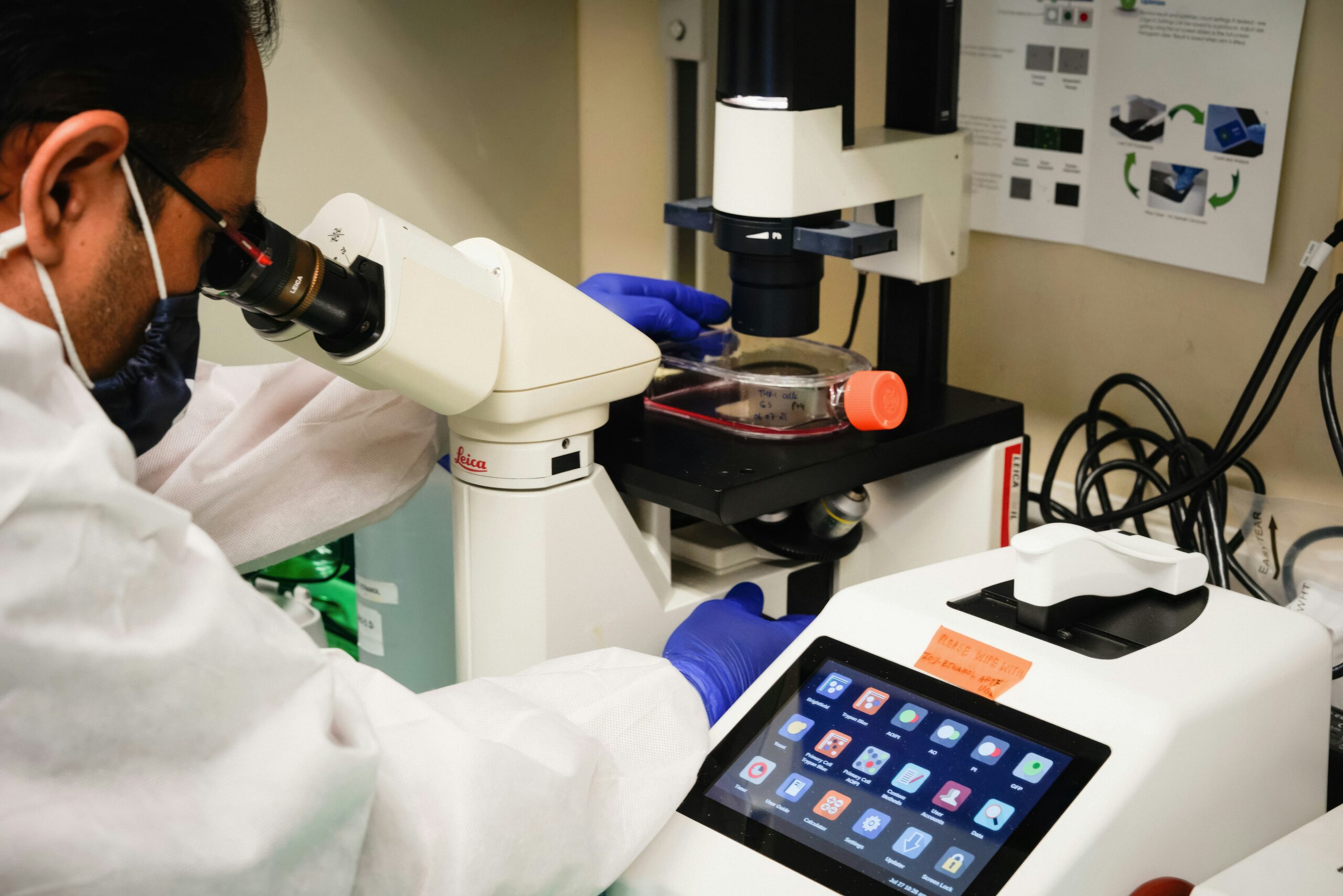
Science for me is a tool that is entirely aimed at looking at material phenomena and understanding what other material causes are at play. If you can measure it, it can be explored using the scientific method. It is most useful for things which happen very frequently. Using the scientific method for one-off or very rare events is usually less effective.
But spiritual theology would say there are many spiritual experiences which have a lot in common.
Yes, I once read a book about a whole group of saints who levitated. Or there are books about and reports of Eucharistic miracles.
A lot of people feel the peace of prayer.
And one can measure this to a point. There are neuro-imagining studies which look at brain activity during prayer and meditation states. There is a lot of spiritual life which does manifest physically but the scientific method is not suitable to conclude that the causes for those physical manifestations are spiritual.
I am not competent to explain what methods faith uses but what has helped me personally is pondering on and living out a spiritual life through regular and constant practices of prayer. So spiritual life has its methods. It reassures me of God’s presence and love and consoles me when I am lost or sorrowful. Science, as much as it enthuses me, doesn’t give me this consolation.
Spirituality helps me explore questions of meaning and purpose and puts me in the right state to be prepared to receive those answers. The only answers which are truly valuable are the ones which come to you from the one who made you and gave you a meaning and a purpose, not the ones which come from your own head. And in that sense, it’s humbling.
What would you say to someone who said we can only trust knowledge acquired through scientific investigation?
This is what is called empiricism. Even if you are trying to follow a hyper-rationalistic approach to the world, empiricism will be very limited because there are lots of things which are inaccessible to merely experimental observation.
Life is much more than what you can perceive, whether it’s through a telescope, microscope or any form of measurement.
Even if you are measuring things empirically, in fact we use a non-empirical method to combine and explain those observations.
What would you say to someone who claimed that their faith led them to put in doubt current scientific consensus: e.g. climate change deniers; people who refused to take the vaccine during the Covid epidemic, etc?
I empathise with these positions because this consensus can often be based on trust in authority and not so much on evidence, and science being a tool can be misused. I think we need to distinguish between a prejudice against science (“I don’t trust scientists”) which might in some cases arise from a narrow religious perspective, for example certain forms of fundamentalism, and valid concerns over ethical questions or concern that a certain scientific approach is biased and only showing part of the issue.
What are the current conflict issues and/or frontier areas between faith and science? Are there areas where they are coming closer together?
The notion that we can explain the world in purely materialistic terms and that this would lead to increased human flourishing, as the fashionable atheists tried to do in the 2010s, is, I think, now being left behind.
Now people are recognising once more the value of faith and spirituality as something that is indispensable for human well-being. Even people who are anti-religious are beginning to see a value in spirituality and this might open their minds to what might be true in this.
Broadly, people of faith – except for the fundamentalist minority – have been open to incorporating and appreciating the advances of science and this can actually strengthen their faith as it shows the genius of God.
How does faith contribute to your own work as a scientist? Do scientific findings ever challenge your faith?
It contributes a lot in two ways. Firstly, as a scientist one explores many little things and it helps a lot to think that each one of these, my tiny little experiment, is part of something bigger. Secondly, it keeps you humble, because whether it’s your grand idea which might be a big breakthrough or your obscure experiment which nobody is interested in, they’re both parts of something much greater. So, it elevates the obscure study and grounds the grand idea.
And no, scientific findings don’t challenge my faith. They help me understand it better.
I don’t think there’s anything which can come from pure science which would really be a serious challenge to faith.
You are an epidemiologist? Does this ever tell you anything about social processes, e.g. things going viral on the internet?
I think about that question a lot but I haven’t yet a clear answer. My gut feeling is that they are related – and a lot of scientific findings begin with gut feelings – so I intend to explore this more.
Does your awareness of scientific developments lead you to fear for the future? Is there a danger that our own technological achievements could end up destroying us?
I also think about this. There are specific things which are a concern to me. For example, technologies which evolve very fast before we fully understand what they are doing, like AI. And I am worried when we are over-concerned about whether we can technically do something and not sufficiently concerned about its ethical implications.
An example of this comes to mind. The first is of a certain university which used skin cells to produce full human embryos. Technically it is very impressive and could even be used as a treatment for infertility. But that opens a universe of very questionable scenarios. For instance, one could potentially create a baby with no biological mother whatsoever which is a frightening thought.
Like what you’ve read? Consider supporting the work of Adamah by making a donation and help us keep exploring life’s big (and not so big) issues!

Bernardo Gutierrez
Bernardo Gutierrez is a postdoctoral research fellow for the Oxford Martin School Programme on Pandemic Genomics in association with the Department of Biology and Pandemic Sciences Institute at the University of Oxford. Among other things, his research interests focus on the evolutionary genetics of emerging viruses.

