The power of friendship: the Commonwealth and its role today
We ask Luis Franceschi, who has just stepped down as Assistant Secretary General of the Commonwealth, what this body actually does and whether it still has a meaningful purpose in the contemporary world. This is part one of a two-part article.
Could you introduce yourself and say what exactly your role in the Commonwealth was and what in practice your job involved. What did you do every day? And how did you find yourself in this job?
My job as the Assistant Secretary General of the Commonwealth involved looking after political affairs, rule of law, judicial transformation, democracy, elections, governance, peace, human rights, and countering violence and extremism in the 56 countries which make up the organisation.
So it’s a huge responsibility. We work very directly with each member state. I was in the post from 2020 until February 2026 and every day has been different.
Some days I was in London but I had to travel more than half the time. Perhaps, let’s say, three weeks in a month, from East to West and North to South. The trips were usually very short and to the point. Arrive in the country, deal with the issues at hand, do what you are supposed to do, and leave.
And how did I find myself in that job? Well, I found myself in it by God’s providence, because I did not think of doing it.
I had done a lot of work with the United Nations, with the government of Kenya, the regional courts of justice and finally being the Dean of Strathmore University Law School. I was constantly in touch with practically everyone in government and in the legal sector. Strathmore is hugely prestigious in Kenya, and being a Dean of Law – we had few law schools in the country – was also quite a remarkable thing.
I began the school, I was the founding Dean, and the President of Kenya, when I finished my second term, wrote a beautiful letter recommending me for the Commonwealth job, because they needed someone with my type of experience.
Then the Commonwealth was going through rough some patches and was losing traction on the legal and political front. I had gone to Berkeley Law School in California, and Oxford University for a sabbatical, and then I was called for the interviews, and I went through the whole process. In the end I was selected by a panel which included High Commissioners in London.
Does the Commonwealth still have any meaningful purpose? What would you say to someone who said that it is just an attempt to prop up Britain’s fading influence in the world? What good does the Commonwealth actually do? Does it in practice foster peace in the world and, if so, how?
Yes, absolutely, a huge purpose. You see, the Commonwealth is not the World Bank. We don’t have money. The Commonwealth is not NATO. We don’t have guns.
But the Commonwealth has something really important which other multilateral institutions lack, and this is friendship.
We are not a regional bloc. For example, Kenya or Nigeria cannot run away from Africa. Come what may, they are still in Africa and relating with other African countries, their neighbours. But to stay in the Commonwealth is always a choice.
The Commonwealth is a club of nations, which are very different among themselves, and the only thing they have in common is friendship and the belief in some common values. Friendship that comes in most cases from the birth pangs of being a colony. It is making lemonade out of the lemons. Basically, out of that colonial past that was more or less painful, this friendship was born, where we all share many things.
There are two core elements members share: English and Common law. This allows experiences, jurisprudence and government systems to cross boundaries. We do not need to spend the same penny twice. If one country finds a solution to a common problem, we can easily replicate this across the Commonwealth.
These commonalities make trade also cheaper. Intra-Commonwealth trade is 21% cheaper than doing it with a non-Commonwealth country. This is the Commonwealth advantage. Something similar happens with lawyers, systems, etc. In reality they are shareable. This is why I usually joke with members, “you have the copyright, and we have the right to copy”.
What good can the Commonwealth do? Well, foster peace in the world. We have done that, and we have done that in beautiful ways. For example, in Sierra Leone, in Zambia, in Bangladesh, in Eswatini, in Pakistan, in The Gambia, in Sri Lanka, in quite a number of countries that have found themselves in very difficult situations, we have helped them go through a peaceful transition, reforms, periods of reflection.
This has been done through friendship, because we are in direct contact with the presidents or prime ministers and opposition leaders. We are talking to them. We are visiting them, even in jail, and have helped negotiate their freedom or end a stalemate.
From Britain’s own point of view, is the Commonwealth still of real worth to the United Kingdom? Does it still have teeth or is it just of ceremonial and sentimental value? Do the actual decisions of recent British governments show them taking it seriously?
Certainly, from Britain’s own point of view, the Commonwealth still works.
Truth be told, Britain has a difficult relationship with the Commonwealth Secretariat. Why? Because the Commonwealth Secretariat is somehow the unwanted child of Britain.
In 1948, when India decided to become a republic, there was a huge earthquake to the whole body, because the Commonwealth was the association of realms under the British monarch, who acted as the Head of the Commonwealth.
India’s decision to drop the king would have meant the separation of more than half of the Commonwealth. An urgent meeting of prime ministers of the Commonwealth was convened and they signed the London Declaration, which for the first time allowed republics into the Commonwealth.
This meant a substantial change to the nature of the relationship. The Commonwealth stopped being a club of realms with the King as their head of state, and became a club of equal nations with the king as patron, but not as head of state.
Things keep going until 1964, when three African presidents, Kwame Nkrumah from Ghana, Julius Nyerere from Tanzania, and Kenneth Kaunda from Zambia, decided to come to the UK to say they were leaving the organisation.
“Why are you leaving?” they were asked. And they answered: “Because we did not fight for independence to be part of an organisation that is a department under the Foreign Office”, which is still called Foreign and Commonwealth Office.
So there was panic in London again, and the Secretariat was founded, and the Queen decided, in a very magnanimous way, to give her house, Marlborough House, to the Commonwealth so they could use it as their headquarters, and they could get out of the Foreign Office.
That separation from the Foreign Office was necessary, but it was not accepted by the bureaucrats who wanted to keep a tight grip on Commonwealth matters and decisions. The Foreign Office keeps on comparing us to themselves, even in terms of benefits, salaries, and limitations. We are not FCDO, we are a multilateral organisation. [ed: FCDO is the acronym for what is now called the Foreign, Commonwealth and Development Office.]
So, due to that, the Commonwealth has always been underfunded. I mean, we have a budget, this is public, of less than £40 million. Of this, the UK gives us around £4 million a year. The rest comes from all the member countries. Budget means commitment.
In my opinion UK’s commitment to the Commonwealth is very low. The UK government should be more serious. It has to see the value of this organisation, not to minimise it, but to grow with it.
It is a wonderful avenue for collaboration, trade, impact and influence. After all, no one wants to be a lone verse in this universe.
What benefits do the member countries of the Commonwealth derive from it? How does it help them? Why would Francophone countries like Gabon and Togo, or countries like Mozambique and Rwanda, both without direct British colonial history, have chosen to join the Commonwealth, as they have done in recent years? Are there other countries wanting to join? On the other hand, might France or, in the case of Mozambique, Portugal, be upset that former colonies of theirs are joining the British-led Commonwealth?
The benefits are long-lasting. They will not give you money. They will not give you weapons. But they will make you better as a country, as a government, through collaboration and friendship. It is a family where member countries can ask, “hey, I have this problem. Has anyone among the 56 found a solution?”
And we answer: “Yes, someone found a solution here.” Whatever one country finds as a solution is shared with other countries in governance, in law, and much more. As I said, “we don’t spend the same penny twice.”
For example, India has got incredible systems for e-governance, they are digitising government like crazy, and Singapore is at the forefront of AI. Well, small states like Nauru, Tuvalu, Dominica or even Malawi may not have the money to do that. But India has done it. So, India and Singapore come to the aid of members who need to learn from their experience and benefit from their technical developments. It happens and it is beautiful to watch.
So in that sense, there is a huge advantage. This is why many countries want to join. Togo and Gabon joined in 2022. Mozambique and Rwanda much earlier than that. And they have benefited so much. In 2007, Commonwealth leaders decided that it was not a requirement to have British colonial history because we don’t want to be a club of former colonies. And we have a long queue of countries expressing interest in joining.
Certainly, this could trigger feelings in some former colonial powers. It does sometimes. But we live in a free world. Many of our countries are members of the Francophonie and that’s not a problem for us. There are also members of the EU, like Malta and Cyprus, or of the African Union, CARICOM, or this club or that club. And we usually collaborate and coordinate our actions to avoid replication.
Presumably the Commonwealth in economic terms in no way compensates for Britain’s exit from the European Union. Does Britain hope that with time the economic benefits of the Commonwealth might in some way make up for Brexit? Does Britain see Africa as a burden it still has a duty to prop up or as a growth continent and therefore of positive value from the point of view of its own interests?
You’re right. In no way does the Commonwealth compensate in economic terms for Brexit. The idea that it could was all part of the propaganda linked to Brexit.
“We have the Commonwealth, why would you want to be in Europe?” they said. But that was complete nonsense.
And actually, it was quite condescending because there was an attempt to control somehow the Commonwealth as if it is Britain’s. But this is counterproductive and condescending. Sadly, some of this mentality is in the mind of many UK parliamentarians.
I am really disturbed by the way the UK Parliament often discusses sovereign countries as if they were still colonies. This is particularly worrying in the House of Lords.
We have to remember that these countries do not discuss Britain and Britain’s internal affairs in their parliaments. Yet this is a mentality that has been very pervasive ever since the days of the empire.
So, the Commonwealth is not like the European Union. It is not a supranational mandatory treaty organisation. The Commonwealth is a non-treaty organisation. There’s no treaty. You join because you are accepted in the club and you leave the club whenever you want. We cannot impose rules and regulations on goods, services, etc.
It is true that the idea originally was free movement of goods, people and services, but this has mutated quite a lot, especially after Britain joined the EU.
Here I must say that, in my personal opinion, Brexit was a huge blunder. It left Britain exposed. I see this, for example, in Kenya, where Britain has dropped to the back of the queue. Now, the most important partners are China, US, Uganda, Tanzania, Turkey, the European Union (any EU member no matter how small), then after that, the UK, at the back of the queue.
This is the first part of a two-part interview with Luis Franceschi, who steps down today as Assistant Secretary General of the Commonwealth. Part two will come out on Monday 23rd March.
Like what you’ve read? Consider supporting the work of Adamah by making a donation and help us keep exploring life’s big (and not so big) issues!

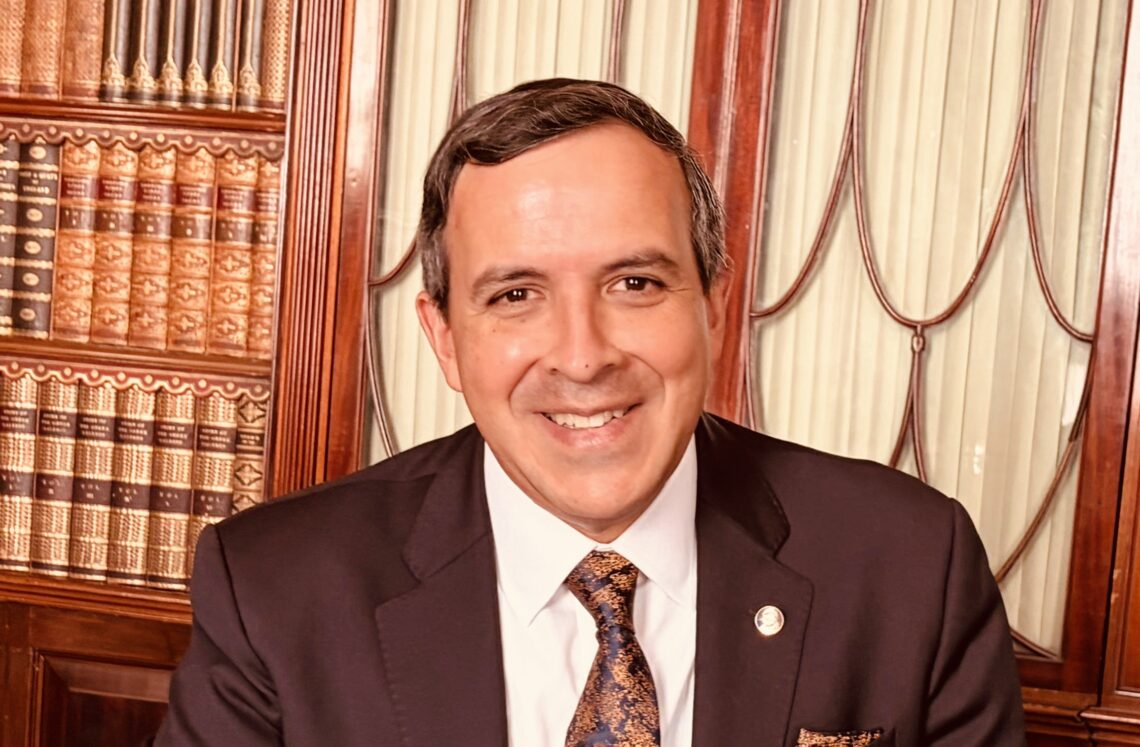
Luis Franceschi
Prof Luis Gabriel Franceschi, LLB, LL.M, LL.D is the immediate past Assistant Secretary General of the Commonwealth of Nations, an intergovernmental organisation of 56 countries, 2.7 billion people, one third of the world. He is a Kenyan Advocate and was the founding Dean of Strathmore University Law School, in Nairobi. As a thinker, educator and writer, he loves positive and disruptive innovation. His area of expertise focuses on innovation in legal education, judicial transformation, peace negotiations, and comparative constitutional law. He has published widely. He has been a legal advisor to several national and international government agencies, commissions and programmes, including international and regional courts, the United Nations and the World Bank. He co-drafted the UN Nairobi Declaration for the Governing Council of the United Nations Environment Programme. Prof Franceschi likes cycling, running and mountain climbing and has reached Point Lenana, Mt Kenya (5000 Meters ASL) five times, Uhuru Peak on Kilimanjaro (5895 Meters ASL) and the Rwenzori Mountains circuit (Uganda-Congo).
