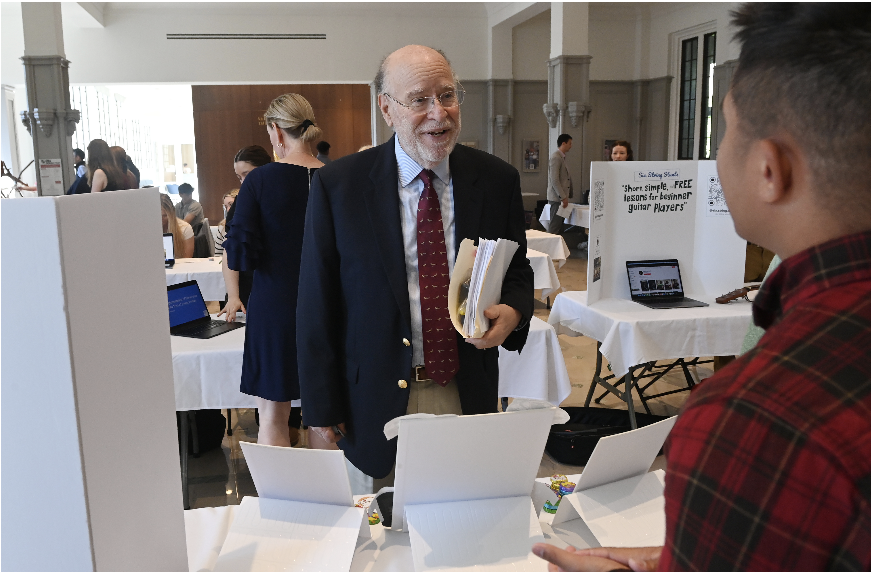
“People who cannot control themselves cannot exercise freedom”
In this fascinating interview, American business ethicist Max Torres spoke to Adamah Media about business ethics, the importance of making good decisions, and why self-control is central to a good economy.
Tell us a bit about yourself: what and where you teach and your research interests?
I teach business ethics and various leadership courses at The Busch School of Business, The Catholic University of America in Washington, D.C. I should say that I taught – past tense – insofar as I retired from the classroom last August.
One of these courses was based on classical writers and figures, i.e. Plutarch and Julius Caesar, and what they teach us; another applied the virtues to sport. The thrust of my work concerns the application of virtue theory to business practice.
I am a native San Franciscan (California), married for nearly 36 years, with eight children and six grandchildren. I studied business at the University of California at Berkeley, law at Harvard Law School, earned my Ph.D. in business ethics at IESE Business School in Barcelona, Spain, and began my academic career there.
My research interest has always been decision-making and its role as the hinge in the formation of both personal character and organizational culture.
Put simply, the decisions we make shape us, individually and collectively.
I try to underscore the intangible factors underlying tangible results and focus on the person as the core of organizational action. My aim is to help students build lives and institutions capable of generating the trust, loyalty, and commitment necessary to sustain them.
I’ve tried to show my students that the most important things are not what you can put a number on, but what makes the numbers attainable, even feasible. Behind efficient and streamlined operations there are intangible factors like trust and cooperation, without which the enterprise won’t flourish. The things you can measure are always important but almost never the determinative consideration.
How do you ‘teach’ decision-making? What constitutes a ‘good’ decision? Or an ‘ethical’ decision for that matter?
Decision-making is key. Our decisions show in concrete actions what we value. They form us as people and form enterprises, and I help students consider how this affects performance, the organization, and society.
I press them to make and explain decisions, thereby ingraining them with inclinations towards counsel (gathering all the necessary elements, also by asking the advice of others), judgment (assessing all these elements, giving each their due weight and establishing priorities) and command (acting effectively on the judgement). Good decisions also involve giving people their due and controlling fears and pleasures.
Business ethics requires that you learn some crucial things about ethics in general, and a lot about business and the kinds of incentives one will encounter in practice. In day-to-day practice, much of it comes down to growth in and reliance upon the cardinal virtues. Every economist will tell you that people follow incentives.
One way to view virtue is as what one needs to resist perverse incentives and to pursue noble ones.
As I said above, our decisions form us. The person is at the same time the subject and object of his acts. We are creating some sort of effect on the outside world, but we are also producing an effect on our interior world, becoming more or less discerning, more or less generous… In short, developing virtues or vices. This is the interior process of what becomes of us because of what we do.
For example, people who pass exams through cheating or sign their names to essays written by ChatGPT are developing bad habits which may well appear at some inconvenient time.
We saw this with the KPMG ‘Steal the Exam’ and ‘Exam Sharing’ scandals of 2017, which saw senior executives cheating in various ways to cover up poor performance on client audits and in-house exams. When the scandals came to light, this prestigious firm was degraded by paying $50 million to settle SEC charges and firing several key leaders, some of whom were convicted and sentenced to prison.
It’s considered the firm’s scandal. But it transpired through the action of people in the firm who made bad choices. These perpetrators were not likely people caught in a pinch who cheated for the first time, but people with ingrained bad habits developed through prior behavior, e.g. cheating in school or on the way up the corporate ladder, or even in relationships. Habits become part of the person possessing them and in turn become the font of that person’s future behavior.
I try to help students to become people capable of using their freedom in a way which is beneficial to themselves, the enterprise they are involved in, and ultimately their society.
Are business ethics in practice possible? Do they ever really work?
They are not only possible; they are integral. And if by ‘work’, you mean ‘put money in your pocket’, the answer is no, or at least not necessarily, though on balance, ethical business is more likely to be sustainable than unethical business.
Ethics ‘work’ not so much in the realm of what you can count or easily measure but in the realm of thought, habit, and human experience. Through these, ethics affect outcomes in the measurable world.
Alternatively, you might be asking if ethics can be taught. Yes, if they can be learned, they can be taught. But ultimately, ethics comes down to what people do, not what they know.
Can there be ethical business? I’ve just been in Oxford reading out a paper which presents empirical research to show the connection between what we teach at The Busch School and how that leads to human flourishing.
Good people make good decisions, including prudent ones guiding all their actions. Business education should above all help people to make prudent decisions: take council, deliberate, evaluate options, judge, and then execute the decision in an effective and appropriate manner.
Having said that, I don’t ground my certitude on empirical research based for instance on the self-reported answers of undergraduate students. Rather, experience and observation have led me to appreciate the explanatory and predictive power of realist ethics, business ethics specifically. I’m simply not likely to improve on the metaphysics and ethics of Aristotle or Thomas Aquinas and would rather apply their insights to modern practice than attempt to reinvent the wheel.
Can ethical business be profitable business? Yes, and it can be unprofitable business as well. The question of profitability is one thing; the question of ethical behavior, i.e. behavior that contributes to human flourishing, is another. They are not directly correlated.
Isn’t ethical business usually politically correct and virtue-signaling business to try to sell more by seeking to take the moral high ground?
It certainly can be, and too often is. Moreover, it’s too often a cudgel with which to beat free market adherents and provide a rationale for state growth and political dominion in the economic realm.
As some wag once quipped, we are living in an era of woke capitalism in which companies pretend to care about social justice to sell products to people who pretend to hate capitalism.
Good ethics lead to good actions. For instance, we may or may not get to specific environmental goals, but we can get to more respect for the environment by living virtues like temperance, fortitude and justice so that we control ourselves, respect others, and respect creation.

The dominant cultural mentality today, at least in places prosperous enough to afford it, is precisely that anything does go and people don’t want to control themselves! This mentality is not sustainable as evidenced by concern over environmental degradation. If not for the sake of common decency or the common good, we will at least learn to control ourselves for the sake of survival on the planet.
You’ve just attended and spoken at a conference on character and virtues, the one in Oxford you referred to earlier. Is there really still an interest for such issues in the world?
I was surprised to see how much interest there is, and how well developed and developing the network of scholars and donors is. One needs only to scan the daily paper to glean the crying need for character and virtue in the contemporary world and business practice.
The sine qua non of freedom is that people control themselves before others must control them for the sake of everyone else’s self-preservation. I am generally an advocate of ‘free markets.’ People who cannot control themselves cannot exercise freedom; they are subject to domination by their whims and appetites. The primary hope for freedom is virtue: control of one’s will and passions by reason, which is itself ordered to a reality beyond itself.
It should be self-evident that simply to indulge oneself, to do whatever one wants, is not safe. People who live this way are not safe for themselves, for their families, nor for society.
We need self-control and virtue. We can’t just rely on regulation. The irony of ever-growing regulation is that no-one can control the regulators either, if these can’t control themselves.
There is no more effective measure of social control than self-control.
And how can we ever possibly agree as to what virtue really is?
All our big disputes about morality come down to our depiction of reality. For example, consider disputes in the sexual realm, such as the politically contentious yet profoundly philosophical questions which America’s Supreme Court is presently being asked to decide on the presumed basis of law, what is a woman?
Can a woman be trapped in a man’s body and moreover be allowed in justice to compete against biological women in sports? Humanity has never believed this to be possible, and until recently, no philosopher has seriously proposed it.

This Conference, now in its 15th year, illustrated to me just how many academics – more than I imagined – concur on principles even if not on politics. I acknowledge that we cannot fully agree on the nature of virtue without agreement on the nature of being and the person, and the purpose of human action, economic or otherwise.
People may not be generally versed in the metaphysics and ethics of Aristotle and Thomas Aquinas. But I suspect that most trudge on in daily life generally guided by the contours of what Aristotle and Aquinas prescribed – certainly by the principle of non-contradiction: that a thing cannot both be and not be at the same time in the same way. Put more simply, it is what it is, things are what they are. You can’t deny or re-create reality without courting what looks like insanity.
What are the big challenges facing character formation and growth in virtue in our current age?
There are many. At the philosophical level, it is the appeal of nominalist ethics that lead one to conclude that things are the way one says or wants them to be rather than the way they are.
If right and wrong are matters of personal preference without any necessary connection to a definite telos – that is, end or purpose – rooted in human nature, then any habit or action will do. As the Chesire Cat tells Alice, if you don’t know where you’re going, any road will take you there.
When we reference character formation and growth in virtue, we have in mind the conforming of self to the way things are, to reality, not the conforming, or often the manipulation or deforming, of reality to oneself, to the way we imagine things to be. In the U.S., we expect accountants to conform their depictions of corporate reality to GAAP, Generally Accepted Accounting Principles, not to the wishes of senior management.
As appealing as it might be to bend the world to our wills and passions, this only results in personal, organizational, social, and political ruin.
We know this in business, which is why no one has ever heard a defrauding CFO, defalcating fiduciary, or philandering manager defend himself by protesting that he was rightfully living ‘his truth’.
Like what you’ve read? Consider supporting the work of Adamah by making a donation and help us keep exploring life’s big (and not so big) issues!

Max Torres
Max Torres, J.D., Ph.D. is the retired Centissimus Annus Della Ratta Family Endowed Professor at The Busch School of Business at The Catholic University of America in Washington D.C. Before enjoying a 33-year career in academe spent mainly in Barcelona, Spain and the U.S., he worked as a financial consultant in San Francisco, California his native city. His degrees are in Business, Law, and Business Ethics, all subjects he has taught and written about. He currently lives in D.C. with his wife of 35 years; they have eight children and six grandchildren. When he is not delivering lectures, presenting papers, participating in colloquia, or teaching short focused programs, his time is spent giving classes of Philosophical Anthropology, Austrian Economics, and Investment Finance to local teenagers.

