‘Doing God’ at the Commonwealth
In this second part of our interview with Luis Franceschi, who has just stepped down as Assistant Secretary General of the Commonwealth, Professor Franceschi discusses colonisation, reparations, dealing with corrupt politicians, and how faith can be a tool for peace.
Does Britain really have an altruistic sense of union with these Commonwealth nations because of the ties which its colonisation of them established? Put simply, are there generous, altruistic motives for keeping the Commonwealth going or is it just self-interest?
It’s interesting because I don’t believe the motives of Britain have been altruistic. In some sense, there were altruistic moments when some of these colonies were being built, not exactly by the British government, but by British people.
Who educated, who went to offer education, who went to teach the locals? It was mostly missionaries, simple people, educators. Yes, missionaries, people from churches, Anglican, Catholic, Protestant, people of a good heart who wanted to go and help and do something meaningful in the world.
But for the British government, this was mostly an economic equation, where companies with commercial interests rushed for control of lands and their peoples. They later transformed themselves into governments, and then mutated into governance systems. But really, there was not much of an altruistic sense, and that’s why there was a lot of segregation.
So, it was not really for the people though, truth be told, many British citizens and missionaries did it for the people.
The government, instead, has always been very pragmatic and utilitarian. What is good for us, and how can we advance our agenda? And certainly, this is true for most countries.
It’s not that Britain advances its own agenda and Kenya or Fiji or Nauru don’t. They all push for their own agendas, and that’s what makes multilateral bodies so complex. It’s each country seeking their own agenda, but in a way trying to see how my agenda fits within the overall union, and how can I make the most out of this relationship. But it’s not much of an altruistic sense.
What would you say to someone who said that Britain’s colonisation of these nations was evil and the United Kingdom only has a duty of reparation towards them? Was the British Empire only bad or did it also bring some good with it?
Look, the issue of reparations is real. Though I don’t believe it is just about money. It’s more about systems. We have to redesign international financial systems and make them fairer, truly inclusive and equitable. Unless we do so we will perpetuate poverty, inequality, illegal migration.
Civilisations have always faced a dilemma, control or be controlled, colonise or be colonised. So, Britain’s colonisation – or French, Dutch, Spanish, Roman, Greek or Phoenician colonisation – obeys basically a fact of nature, that is, we are trying to dominate so as not to be dominated.
What I think reparations really mean is changing the oppressive structures that create and perpetuate injustices and inequality.
For example, if you think of the World Bank, the International Monetary Fund, the lending systems, the Paris Club, etc, there are quite a number of things that are really not working as they should. We run the risk of keeping the developing world forever developing and the developed nations developed. This social gap is perhaps the greatest risk to progress for both the rich and the poor.
At the same time, there is a very poisonous talk of decolonisation, which is quite negative. I mean, decolonisation should be a positive thing: it’s saying, look, this is who I am, this is what I now want to do. But this naïve idea that everything was perfect before and the colonialists came and spoiled it is just superficial romanticism.
Could it happen that another nation becomes the dominant power in the Commonwealth and Britain has only a minor role?
Yes, of course. India is growing very fast and becoming more and more powerful. So, it can certainly happen. There are other nations too growing fast and well but, sadly, the self-centred approach of successive British governments has been a huge disadvantage to the United Kingdom.
Presumably in your job you have dealt with political leaders of all types, some honest and upright, others corrupt; some democratic or at least ruling fairly, others tyrannical and even brutal… How do you feel about trying to foster bonds of friendship with people who might be acting far from ethically in the own nation?
Yes indeed, I deal with political leaders of all types. I know practically the 56 prime ministers or presidents, ministers of foreign affairs, justice and many more. I have been with them and, you know, the beautiful thing is that everybody needs help.
I’m shocked and surprised at how many presidents or prime ministers pray, how worried they are for their countries.
They know sometimes that they are doing a bad job. They know they are not reaching as far as they should. They try to justify themselves.
But on occasions a word like, “I pray for you; let’s pray for this; gosh, I know this is hard and I wish you all the best; look, this is not the right thing to do; this can have these consequences”… a sincere and fraternal word of advice like that, can seem very, very handy.
In some countries where power structures are very difficult and complex, some prime ministers have told us, “please talk to the president or to the head of state about this and this, because I can’t”. Sometimes there have been problems between presidents and former presidents. And then, we have to intervene and tell the guy, “look, you can’t say this, you can’t go around saying that, you are a former president, let’s try to forge identity”, and the like.
So, it’s true, some of them are tyrannical, some of them may be brutal, but all of them need help. And sometimes you could think, I will not talk to this guy because he’s dishonest, he’s a thief and has killed people. But precisely, if that communication is broken there is no way to help so that people may stop dying or leaders may become more accountable. Maybe a word at the right time, in the right way, might make that person reflect.
We need to think always of the people first. And that’s why, when I am told “you should throw this or that country out of the Commonwealth”, I ask “how will this help the people?” The answer to this question should be our first point of consideration.
Once you throw somebody out, you close all doors. And that’s precisely what you don’t want to do. Okay, you throw them out when there is no choice, when they have done something blatantly against the values of the Commonwealth. These are circumstances which are totally opposed to its values. But in many cases, it’s not that simple, it’s bad governance, or excessive ambition, or arrogance, or lust for power, and we have to deal with these things.
We are seeing the breakdown of understanding between peoples and groups in many parts of the world (Russian and the Ukraine, Israel and Palestine, civil war in Myanmar, the Yemen and Sudan conflicts, drug violence in Mexico, Boko Haram in Nigeria, and so much more). Why do you think this is happening? Does it say something about our age? Does the Commonwealth offer any model which might help to resolve these conflicts?
Yes, you see, before the Second World War two things happened. The League of Nations collapsed and the arms race was triggered. And sadly, we are seeing a similar situation today.
The United Nations is collapsing (its own Secretary-General has said this), and NATO is the only organisation that is doing exceedingly well. All the countries have met expectations and surpassed them in terms of budget contributions.
And you ask, why is this happening? Because dialogue has been broken. The United Nations is not useless. The assembly, the General Assembly, looks like a useless event and a waste of money, but you close it down at the price of peace. If you do not keep presidents talking to each other, they start shooting each other.
I mean, it’s a scandal that we have been at war for four years in the Ukraine. We are coming to the fourth anniversary of the conflict, and the first time officials – not even Putin and Zelensky, but officials of Russia and the Ukraine – met was in April 2025, three years after the war began.
So, this is absurd, because they have been killing each other for four years without ever speaking. This is a UN failure, this is the failure of common sense. And the same is happening with Palestine. The same happens with very many of the 58 conflicts we have in the world today, where leaders like children have huge egos, and they do not dialogue.
That’s scary because some people speak of the Third World War. Well, the Third World War, in a way, has started. Perhaps in the history books of the future they will write that. When did the war begin? Well, maybe they will say it began with Ukraine, or it began with Yemen, Afghanistan or it began with Israel, Iran…
But certainly, there are so many triggers of violence due to a lack of dialogue, due to lack of true magnanimous leadership. And that is why the Commonwealth is so important as a model, because we reach the leaders, and we put them together. So, basically, it’s friendship with a purpose.
That’s how I define the Commonwealth, by the way, nowadays. It’s friendship with a purpose.
How does the Commonwealth, as an organisation, view Donald Trump and his actions and declarations?
Well, the US is not a member. Personally, I feel the US is too polarised, and polarisation happens when emotions are placed above reason.
We have a deficit of magnanimous, humble leaders. This scares me.
I think we have to cultivate understanding, unity, go back to the essentials, back to virtue, and back to the common good. Not only the US, but all of us. Are we acting for the common good?
You are a devout Christian. It is known that you and the previous Secretary-General of the Commonwealth, Baroness Scotland, both of you practising Catholics, would arrange to go to Mass on your journeys if this was possible. How does faith affect your daily work? Is there any conflict between your own life as a Catholic, and therefore with at least a moral allegiance to the Pope, and your role as a servant of the political body which is the Commonwealth?
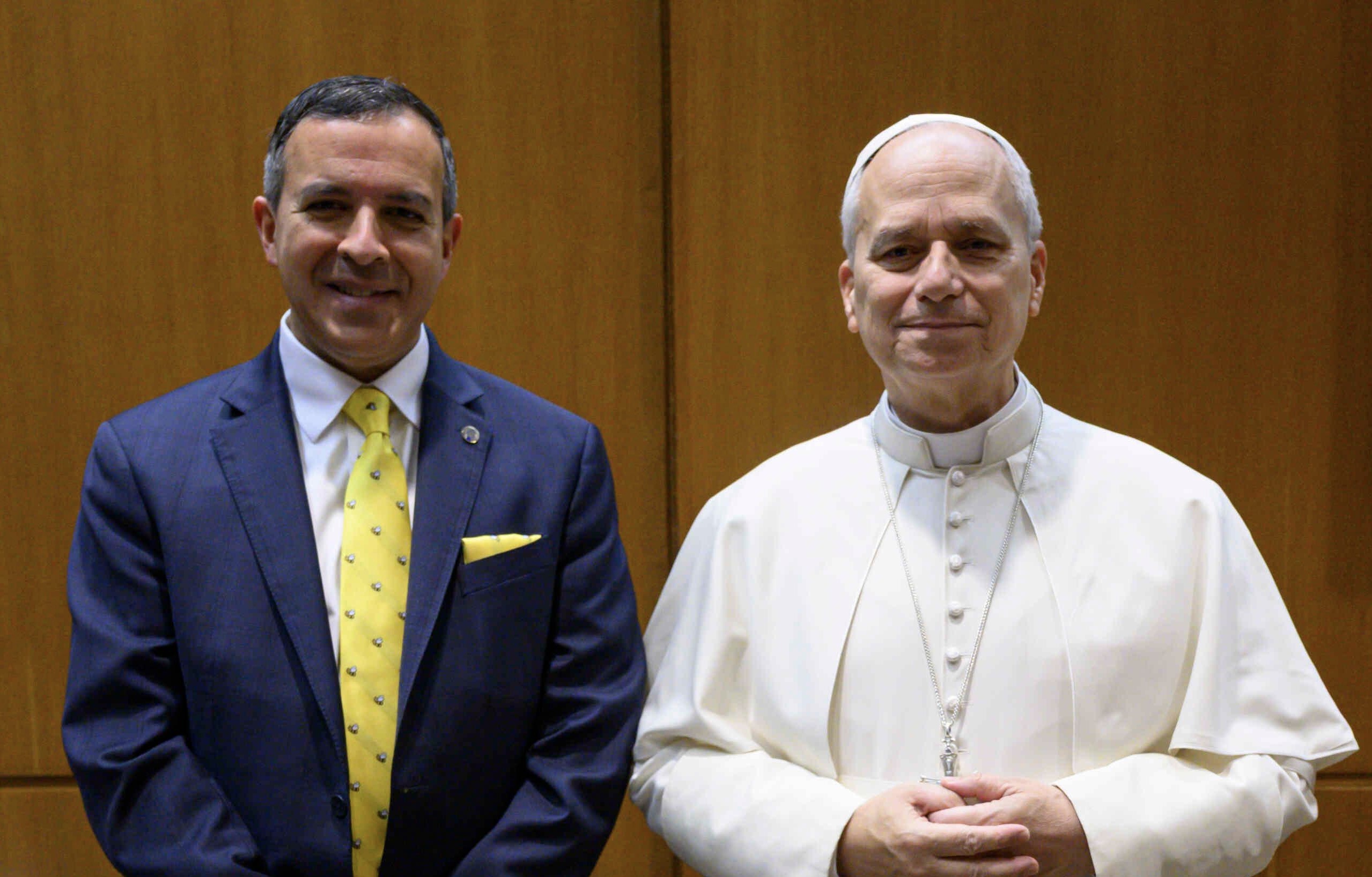
This is a very interesting, very beautiful, topic. Because I had the chance recently of being with Pope Leo XIV, and I spoke to him about faith in the Commonwealth and what we have done to make people see faith not as a divider, but as a unifying factor, as a tool for peace.
I told him the 2025 Commonwealth Peace Prize had been given to a Muslim imam and to a Protestant bishop, who have worked for 30 years to bring their communities in Northern Nigeria together. At first they were sworn enemies. The bishop is missing his right hand which was cut off by the imam himself. The imam’s brother and cousin were killed in a revenge attack by the bishop. The government got the communities together and this was the beginning of a transformational change.
The imam read the Bible and the bishop read the Koran. And one said to the other, “you will not convince me Christ is the Son of God”. And the other one said, “you will not convince me Muhammad is the last prophet. But we agree, we have to work together to stop our people from killing each other.”
These are really touching experiences. And every time I go for Mass, and I try to go to Mass every day, even on my journeys, if possible – because sometimes there are places where there is simply no Mass and so it was impossible – but at all moments, really that somehow renewed in me the necessity of love, you could say.
Love what you do, how you do it, and love the people for whom you do it, and the people who do it with you.
In my team I have Muslims, Protestants, Hindus, Buddhists, and we have a fantastic relationship. We get along so well and it’s wonderful. One of my colleagues is a deeply devout Muslim, and she saw me going for Mass, and she said, “whenever you go to Mass, I will also make a point of going to the mosque”.
When I arrived in the Commonwealth, they told me, “we don’t do God here”. I answered, “Well – and Patricia Scotland in that was very strong and said it too – now we do”. Because 99% of our people across the Commonwealth are people of faith, one faith or another, and those of no faith are relatively few. They have to feel also included, and that’s why we said whatever your faith or those of none, all have to feel included, because faith is a reality in life.
It somehow helps you be who you are, and gives you a sense of identity, and that identity is believing that one God should not be a reality that separates us, but which actually unites us and makes us brothers and sisters.
Believing in one God as a father is understood in many different ways across the world, but sharing that faith with others I think has been a very important aspect of my work.
Whenever I have met King Charles, I’ve told him “I pray for you”, and he was always so, so grateful, and he told me several times, “are you praying for me? I need every bit of prayer I can get”. And when he met Pope Leo, they prayed together.
So faith should not divide us. We respect each other’s belief. We understand them. We may disagree with the way they think. I mean, you can even disagree with your own mother on her opinion about something, but that doesn’t mean you love her less.
That has been a very important lesson for my life, and I’m so grateful to my colleagues who are people who deeply respect and admire the courage to practice one’s faith even in the most difficult circumstances.
And some of them have told me, “Luis, I think you’re always somehow peaceful and joyful because of the Eucharist, because of your faith”. And inside myself, I said, “Yes, the Eucharist, it is the Eucharist that gives you the strength every day to fight new battles and to pray for everyone, for those around you, for the leaders, for the people.”
And besides, something I have learned is that going to Mass in a lost parish in the middle of Fiji or Kiribati or Malawi or India, where there is a very small percentage of Christians and Catholics, teaches you a lot, because you really see a lot about society in a simple church.
This was also deeply touching to those drivers and policemen who often accompanied me to church. For me it was not performative or showy, but a deeply touching experience of putting people, work and God together. A call to be men and women of valour and honour.
This is the second and final part of the interview with Luis Franceschi, who has just stepped down as Assistant Secretary General of the Commonwealth. For part one, click here.
Like what you’ve read? Consider supporting the work of Adamah by making a donation and help us keep exploring life’s big (and not so big) issues!

Luis Franceschi
Prof Luis Gabriel Franceschi, LLB, LL.M, LL.D is the immediate past Assistant Secretary General of the Commonwealth of Nations, an intergovernmental organisation of 56 countries, 2.7 billion people, one third of the world. He is a Kenyan Advocate and was the founding Dean of Strathmore University Law School, in Nairobi. As a thinker, educator and writer, he loves positive and disruptive innovation. His area of expertise focuses on innovation in legal education, judicial transformation, peace negotiations, and comparative constitutional law. He has published widely. He has been a legal advisor to several national and international government agencies, commissions and programmes, including international and regional courts, the United Nations and the World Bank. He co-drafted the UN Nairobi Declaration for the Governing Council of the United Nations Environment Programme. Prof Franceschi likes cycling, running and mountain climbing and has reached Point Lenana, Mt Kenya (5000 Meters ASL) five times, Uhuru Peak on Kilimanjaro (5895 Meters ASL) and the Rwenzori Mountains circuit (Uganda-Congo).
