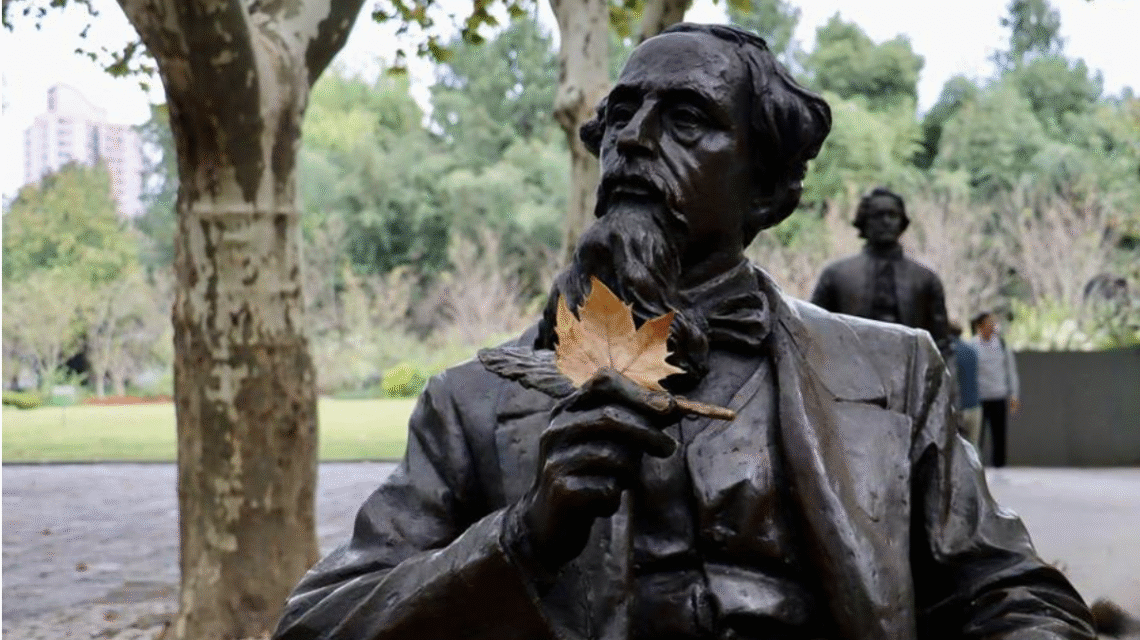
Charles, can we come to an arrangement?
As she dutifully wades through Dickens’ Bleak House, Monica Sharp recalls adolescent traumas provoked by reading the famous English author. Can this great writer but flawed man be liked, or must he only be admired?
Three weeks in with the reading group over at A Public Space in Brooklyn, New York, and I am already deep into Chapter 30 of Bleak House. Appropriately autumnal for the Tuscan season here in my adopted Italy, the narrative swirls in a dense fog of London Chancery courts, social squalor, and meticulously drawn grotesques, magnificent in scale and execution.
And yet I begin not with praise for the Victorian master but with a confession of literary guilt, for I read Charles Dickens out of an acute, almost religious sense of obligation, and not for the aesthetic pleasure or emotional connection I so often seek from literature.
This internal resistance, along with my historic failure to appreciate a writer deemed so essential to the Western canon, is the central conflict when I square off against Dickens. It’s not a simple preference like choosing Austen over the Brontës, but rather more a sense of having somehow failed a cultural litmus test.
Dickens towers with a prolific shade over the literary landscape, practically demanding reverence. By contrast, another favorite author like Jane Austen offers insightful gentility, inviting the reader into the comfortable parlor of domestic realism. Austen is approachable, friendly, companionable and witty.
Dickens, with his vast social epics and crushing moralizing, feels like a necessary, daunting piece of homework.
I took up Bleak House last month on a quest for aesthetic redemption in an attempt to dissect the origins of this lifelong blockade, which ranged perhaps from youthful trauma and disastrous classroom introductions to ethical considerations regarding the author’s own ignominious personal life.
Could I, as a mature reader, overcome my fundamental aversion to truly connect with Dickens’s genius? Here I attempt to answer the central, unifying question that anchors my current (and frankly ambitious) reading project: Charles, could I learn to love you? Can we come to an arrangement?
Oh, he has his fans, in legions. Some are absolutely crazy for Dickens. Their enthusiasm is the foundational bedrock of a certain corner of literary culture. Are you crazy about Dickens? Or are you like me: more meh? My reluctance, I suspect, may be rooted in the common trauma of the compulsory syllabus. Were you perhaps forced to grapple with his monumental scope and dense prose at a tender, entirely unprepared age?
The Ghost of Education Past
My aversion to Dickens is not an intellectual critique that evolved over time, but a defensive reflex whose roots I trace back to ninth-grade English class. The text: Great Expectations. The instructor: the magnificent, combustible Mrs Betty Shipley (+1998), poet Laureate of Oklahoma (1997-1998).
A complicated woman of deep convictions, Mrs Shipley viewed Dickens as essential and ran a classroom whose intense, high-octane environment was disappointed by juvenile failure to grasp the profound tragedy of Pip’s journey. My scholarly shortcomings as a young student felt to me like a moral failing.
As a fourteen-year-old, I was entirely unprepared for this kind of emotional and historical density – or my own emotional response. It was less a literature course and more an immersion into a world for which I lacked the necessary emotional or historical scaffolding.
This is where the concept of literary readiness becomes vital. Some masterpieces, such as the works of Woolf or Melville, demand not merely maturity, but a specific life experience – a certain historical distance, or at least a foundational understanding of social context – that even those most voracious young readers simply haven’t had time to build.
To present the vast, moral canvas of Dickens to a teenager is to ask them to interpret an opera while only having learned the names of the notes, or to frame a house having only handled a handsaw.
The scale of the social commentary was overwhelming. The history was obtuse and opaque. I was stranded.
The lasting artifact of that semester wasn’t a profound understanding of social mobility or convict ships. No, I took from Dickens a single, visceral, and terrifying visual memory.
Because the text itself remained a frustrating blur, my teenage brain clung desperately to the film adaptation we watched in the classroom on a VHS videotape flickering across a TV rolled in on a steel cart.
The image that seared itself into my mind was that of Miss Havisham, the spectral bride trapped in her dusty wedding dress, engulfed in flames.
That traumatic spectacle of decay and combustion, rendered in VHS quality, proved too powerful. All other ancillary recollections of my brief encounter with Great Expectations were instantly and violently overshadowed by the sheer gothic horror of a woman on fire. The dramatic climax drowned out the social and psychological themes of the novel, cementing Dickens as an author of disturbing, unyielding spectacle rather than empathetic insight.
The author and the Aesthetic Contract
If childhood trauma created the initial barrier, the facts I learned about Dickens the man cemented the resistance. As an older reader, my focus shifted from the narrative spectacle to the integrity of the narrator, and here the author becomes his own undeniable obstacle. It is difficult to reconcile the fierce moralist behind Bleak House, the passionate critic of social injustice, with the ignominious man who so cruelly treated Catherine Hogarth, his wife and the mother of his ten children.
Films like The Invisible Woman (2013), which detail Dickens’s obsessive, secretive affair with the actress Ellen Ternan and his public, humiliating dismissal of Catherine, foreground this ethical problem. I am forced to reconsider a profound question that lies at the heart of literary theory: Can we fully appreciate the progressive social ethics and moral clarity within the books when the author himself was deeply and ethically flawed in his domestic life?
This feels like a failure of the Aesthetic Contract, wherein both writer and reader should meet meaningfully on the same moral and conceptual page. Yet when the words on the page demand compassion and human dignity, and the biography of the writer screams of domestic cruelty and hypocrisy, the reader is left asking: WHAT (the literal) Dickens…?
If the facts of the historic author form a barrier, the text can come to feel inaccessible, regardless of its objective genius. Abundant examples of additional problematic authors come to mind, yet as a rule, being a bit of a literary deconstructionist, I don’t like to let the facts of the author’s life impede my appreciation of their work. But something about Dickens, the ten kids, his wife and his much younger mistress, always stuck in my craw.
In defense of the reader: on literary theory and censure
My commitment to literature is historically rooted in the search for genuine aesthetic pleasure.
Reading rewarding literature is like getting a thorough massage on the inside of my mind.
This regenerative, deeply personal act demands reciprocity: I give my attention, and the book rewards me with insight, beauty, or compelling narrative.
Approaching Dickens, however, flips this contract entirely. The pleasure is secondary to the duty and becomes instead an academic obligation, a mental weightlifting exercise to prove my commitment to literature, a formula antithetical to the principles that direct my reading life.
This philosophy allows me to defend the reader’s right to abandonment – a right I was not granted in ninth grade. Again, some texts require a cognitive patience and historical context that youth has not yet acquired.
For the young or the unprepared, Dickens’s prose isn’t merely long, it’s texturally difficult. The words, the clauses, and the tangents accumulate, making the reading experience feel like trying to find semantic meaning in a sheet of marbled paper: the patterns are beautiful and complex, but the meaning itself is opaque, nonexistent even, substituted by an abstract design.
I distilled my central, universal literary philosophy a few years ago when talking to a younger relative who asserted he did not like reading, even though he’d tried mightily: It’s not that you don’t like reading; it’s just that you don’t like what you’ve read so far.
This concept is essential for the modern reader, serving as a robust defense against literary censure and the cultural guilt that plagued my initial engagement with Dickens. I refuse to let one overwhelming book or one overwhelming author taint the entire enterprise of literature and the innumerable gifts its many successes have brought to me.
The mature reader reserves the right to choose their battles, to seek out the pleasure, to treasure the knowledge, and to surrender the guilt.
The Second Chance & The Annotation Strategy
The theoretical defense is finished. The history is known. The time for surrender is over, and the time for strategy has begun. I like a nice challenge. My current reading of Dickens is not a solo, self-punishing endeavor; it is a meticulously planned operation against my own literary trauma. Thus do I take up Bleak House.
My first strategic surrender was to purchase Bleak House: The Norton Annotated Edition. This version is not merely a book. It is a necessary crutch, an academic scaffold built specifically for the modern reader entering the High Victorian era. Every obscure reference to a legal statute, every defunct piece of London slang, every historical context note is explained in the margins or the footnotes.
Without this map and lexicon, attempting to enter Dickens’s sprawling, context-dependent world is an exercise in frustration. Using the Norton Edition is an acknowledgement that true appreciation sometimes requires admitting you need an expert guide to bridge the 170-year gap between the book’s initial publication and today.
The second, and perhaps most crucial, anchor is the structured community. The reading is anchored by A Public Space of Brooklyn hosting APS Together, and the daily notes shared by author Yiyun Li on social media. This community provides the discipline and the essential pacing that a solo attempt would surely lack, transforming a solitary intellectual struggle into a shared, communal experience.

The Husband’s Counterpoint
My husband Jason, a professor of literature, intervened in my guilt spiral with a necessary reminder: Dickens wrote serially, his output intended for an enormous audience who consumed the novels in weekly installments.
His novels were never meant to be gorged in a matter of weeks, as modern readers are accustomed to doing, but rather spaced out in measured, steady readings over the course of a year and a half.
This original pacing may hold the key to understanding the Dickensian aesthetic. When the reader consumes 800 pages too quickly, the fare becomes rather too rich: the unrelenting detail, the cyclical return to moralizing, and the sheer volume of characters simply offer too much to absorb in a briefer period.
The serial format, by contrast, allowed for digestion, for anticipation, and for the necessary forgetting of minor details, creating breathing room denied to an ambitious binge-reader.
This insight grants permission to slow down but also highlights the challenge: I am attempting to force a nineteenth-century object into a twenty-first-century methodology.
Conclusion & invitation
Two weeks into Bleak Book (sorry! I meant Bleak House), I remain quite literally suspended in the conflict. I am at Chapter 25, the novel’s vast social machinery grinding on, but the central question of this essay – Charles, could I learn to love you? – remains unanswered.
The initial guilt has been replaced by a grudging respect, a tactical appreciation for the author’s relentless genius. I am overcoming the trauma of young readership and have established the defense of my right to pleasure, yet the act of reading Bleak House still demands more discipline than delight. That reading calendar is real. Every day, somehow, I’m tearing through 30 pages thin as onion skin.
The great hope, however, is that this time, the scaffolding (the annotated Norton Edition) and the community (the reading group) will allow the aesthetic contract to finally be fulfilled, permitting the Dickensian gems to shine through his dense prose and complicated web of plots and subplots.
To engage with a classic, even with acknowledged resistance, is to participate in the magnificent, messy conversation of literature.
The true joy of reading lies not in passive consumption, but in the active, conscious effort to bridge the gaps of history and experience, even if the author is, by all accounts, a complicated figure.
Despite the grudging respect, the act of reading Dickens is still fraught for me with specific intellectual challenges, particularly concerning his social frameworks.
The sexism often feels pervasive, presenting young women with depressingly limited arcs: they are either trying to elope, become a dutiful lady’s maid, or waste away in saintly patience. Given Victorian morals, one might wonder how a father and creative breadwinner in a traditional marriage with ten children could have ever hoped to truly understand women.
Similarly, his treatment of class and justice, while loud, often feels more like a detailed illustration of an issue than a powerful indictment demanding action instead of tacit or even explicit acceptance of the status quo.
This tendency to moralize often reduces the male characters, too, into symbolic figures – the young man either a dark victim of fate or a bright repository of faith – rather than complex psychological portraits. These ingrained Victorian biases are the final, stubborn knots in my arrangement with Charles, and will demand continuous critical effort to untangle.
This is my arrangement with Charles Dickens: I will continue the journey toward literary conversion, chapter by chapter, in the hope that, eventually, the duty will dissolve into genuine pleasure, or some form of reward or wisdom yet to be determined.
If you love Dickens or hate him, why? Drop a comment below. I love to give bad first impressions a second whirl.
A first version of this piece appeared on Monica Sharp’s Substack. You can read more of her writing at https://monicasharp.substack.com/
Like what you’ve read? Consider supporting the work of Adamah by making a donation and help us keep exploring life’s big (and not so big) issues!

Monica Sharp
Monica lives and works in Florence, Italy. Her international spirit travels with an American passport but she's long since lost count of all the relevant metrics. She currently moonlights as a legal researcher for a local law firm, and prior to that, pursued careers in international education and software. Her off-hours in Italy are filled with a creative buffet of writing, art, music, reading, parenting, and more. Monica frequently writes about cultural forays, interpretive adventures, and close observation.

